
Economy & Markets #51 - Europe finances Ukraine, Washington confronts Venezuela


This week's topics:
On the geopolitical front, US involvement in Ukraine is diminishing, leaving Europe facing difficult financing choices. The debate over using frozen Russian assets held at Euroclear touches on fundamental questions about trust in the global financial system.
The escalation surrounding Venezuela and the absence of a swift peak in petrol demand show that energy has once again become a geopolitical power tool. Fossil fuels remain relevant worldwide, while Europe's energy transition is colliding with physical, economic and geopolitical realities.
Market update – oil price, US CPI and overly restrictive monetary policy
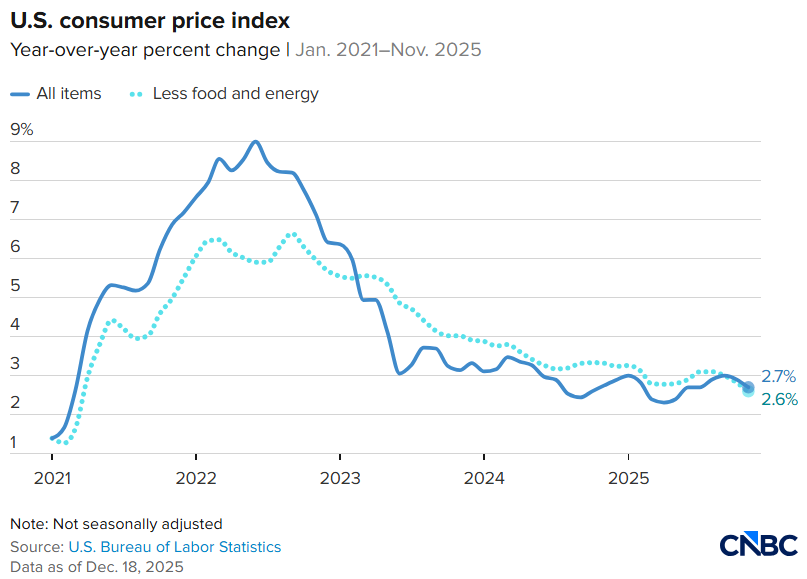
The US consumer price index (CPI) for November 2025, published on Thursday, came in clearly lower than expected. Year-on-year inflation stood at 2.7%, against a consensus forecast of around 3.1%. Core inflation also continued its downward trend, falling to 2.6%. An important explanation for this further cooling lies in the sharp decline in the oil price. Whereas a barrel of oil traded at around USD 85 a year ago, the price now stands at around USD 55 per barrel. Lower energy prices, combined with limited pass-through from import tariffs, are now visibly dampening inflation and easing the financial pressure on the American consumer.
This development fits the broader macroeconomic picture we have outlined before: a pronounced K-shaped recovery in the United States. Technology-driven and capital-intensive sectors continue to deliver growth and profitability, while a large share of households barely benefit from this. For the 'lower leg of the K', real wages largely remain stagnant, while interest-rate-sensitive parts of the economy, including the housing market, consumer credit and smaller businesses, are clearly cooling as a result of persistently restrictive monetary policy.
Against this backdrop, we consider the Federal Reserve's current focus on inflation risks too one-sided. With weakening wage growth, partly driven by increasing AI adoption, structurally lower energy prices and a visible pullback in credit-driven economic activity, the macroeconomic balance has shifted. In our view, the Fed has sufficient room to begin easing monetary policy earlier than currently priced in, without losing sight of its inflation target.
Financial markets responded positively to the lower-than-expected inflation figures. Equity markets recovered, long-term US government bond yields fell and the dollar weakened slightly. Investors are thereby anticipating greater scope for the Federal Reserve to gradually ease monetary policy in 2026.
At the same time, technology stocks came under pressure earlier this week. The market is taking an increasingly critical view of the financing of the large-scale investments required for AI infrastructure and data centres, particularly when these can no longer be funded entirely from internal cash flows. In this context, the news surrounding Blue Owl Capital drew particular attention. Blue Owl is a large American alternative asset manager specialising in private credit and direct financing of capital-intensive projects, including data centres. The company plays a key role in debt financing for hyperscale infrastructure, precisely at a time when traditional banks are becoming more cautious – a development that Jamie Dimon recently characterised with his warning about "the cockroaches in the structured credit market".

According to several media reports, Blue Owl this week halted talks about participating in the financing of a large-scale data centre project with Oracle. This reportedly concerns a planned project worth around USD 10 billion in Michigan, intended to provide AI infrastructure capacity for OpenAI. Blue Owl's withdrawal caused unease among investors and triggered a sharp share price reaction at Oracle, and was seen as a sign of growing caution around capital-intensive technology and infrastructure investments.
Some nuance is warranted here. Both Oracle and Blue Owl have indicated that the reporting may be incomplete or inaccurate. Oracle stated that the project will proceed with a different equity partner. Nevertheless, available reports indicate that the initial financing negotiations with Blue Owl were indeed terminated, underscoring the market's sensitivity to financing risks.
The growing reliance on more expensive and less liquid capital underscores that it is precisely within the technology sector – often seen as the primary growth engine of the US economy – that the impact of prolonged restrictive financial conditions is becoming increasingly visible. As a result, monetary tightening is no longer confined to the rate-sensitive parts of the 'lower K', but is also starting to feed through into the capital structure and investment appetite of the leading growth sectors. The likelihood that the Federal Reserve will cut rates as early as January has thereby increased significantly.
Euroclear, Ukraine and frozen Russian assets
The war in Ukraine has led to an unprecedented deployment of financial and fiscal instruments by Western countries. What was initially presented as temporary emergency support for a regional conflict has grown into a structural financing commitment of historic proportions. That arrangement is now coming under increasing strain.
A central cause is the fundamentally changed stance of the United States. Whereas Washington, under the Biden administration, acted as the dominant financier of both military and direct budgetary support, that role has changed abruptly since the change of administration. The US willingness to cover long-term shortfalls in Ukraine's public finances has disappeared. President Trump explicitly positions the conflict as a European problem and is shifting strategic focus towards the broader geopolitical balance of power with China. Within that framework, Russia is seen less as a primary adversary and more as a potentially pragmatic player within a changing geopolitical landscape.
The consequences of this policy shift are already visible. According to the Ukraine Support Tracker compiled by the Kiel Institute, US contributions have come to a virtual standstill since the start of this year. In total, the United States and Europe together have provided around USD 400 billion in military and economic support, but that headline figure masks a fundamental problem: Ukraine has become structurally dependent on external financing. In the first quarter of 2026 alone, a financing gap of an estimated USD 135 billion is expected to emerge.
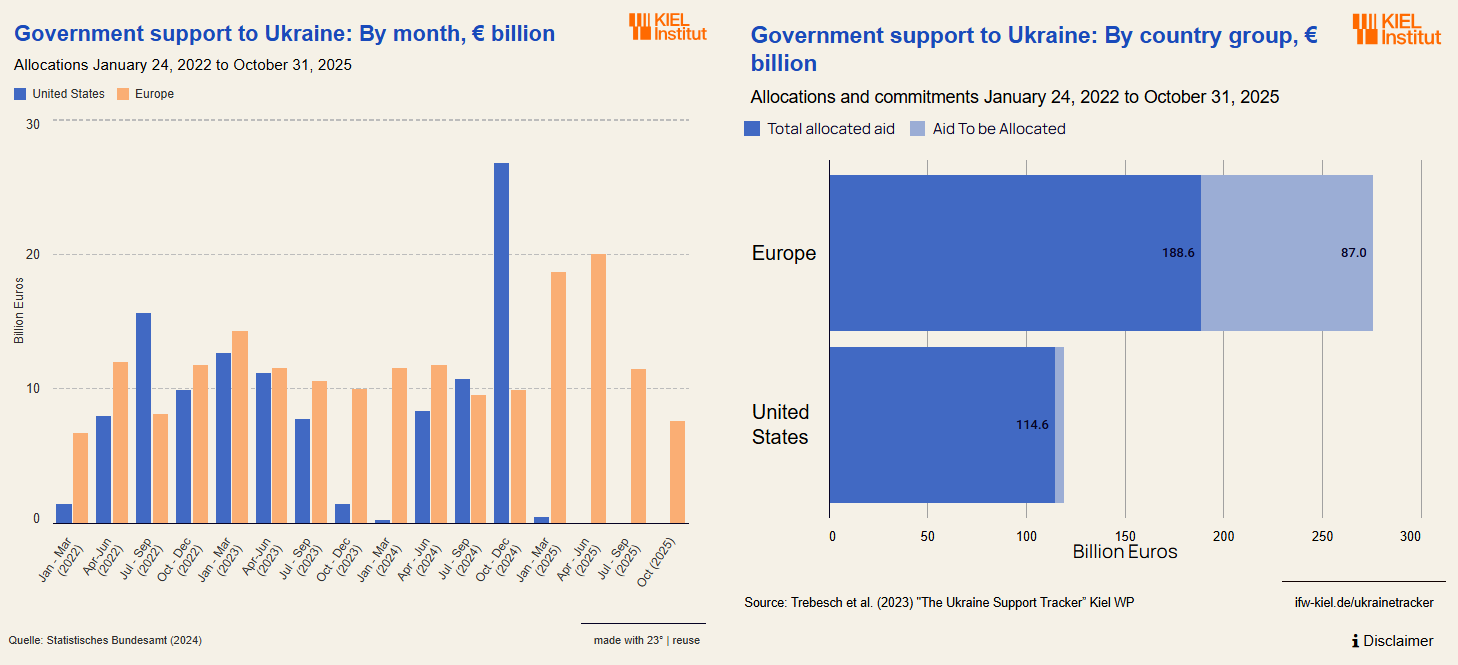
For Europe, this implies an abrupt redistribution of the burden. European governments and institutions will need to reach agreement on additional financing, even as political and fiscal room for manoeuvre remains limited. National budgets are under pressure, joint EU debt remains politically sensitive, and willingness to raise taxes or issue substantial new debt is low. Germany in particular continues to resist joint bond issuance, fearing it would set a precedent for debt mutualisation.
Against this backdrop, attention has shifted to Euroclear in Belgium, which is estimated to hold around €210 billion in Russian central bank reserves. These assets are frozen but not legally confiscated: Russia formally remains the owner but has no power of disposal over them. The key question is how Europe can put these assets to economic use without crossing the legal line into outright expropriation. Current plans therefore focus on using the interest income as the underlying cash flow for a multi-year loan to Ukraine.

The United States has explicitly adopted a cautious stance towards confiscation. The concern is that expropriating sovereign central bank reserves would set a dangerous precedent and structurally undermine confidence in the dollar, and more broadly in the global reserve system. This caution is well grounded historically. Earlier precedents are only partially comparable. After the Second World War, German assets were used for reparations, but only following a formal military defeat and as laid down in peace treaties. In later cases, such as Iran (1979), Libya (2011) and Afghanistan (2021), the states involved had contested legitimacy, or the arrangements were bilateral and humanitarian in nature.
What makes the current situation exceptional is the combination of factors involved: these are assets of a functioning and internationally recognised central bank, held at the very core of the global financial system, that are being considered for the structural financing of a third country during an ongoing conflict. Central bank reserves have traditionally been regarded as the ultimate anchor of monetary certainty. Once their inviolability becomes politically conditional, perceptions shift regarding reserve currencies, clearing and settlement infrastructure, and ultimately the security of ownership under sanctions regimes.
This explains why not only Russia but also third countries with substantial reserves are closely following these developments and reconsidering their allocation decisions. The debate around Euroclear is therefore more than a stopgap budgetary solution; it constitutes a stress test for Europe's financial and institutional architecture, as well as a litmus test for the ambition to position the euro as a global reserve currency. Whereas the United States appears acutely aware of this precedent-setting effect, that awareness is notably absent among several European heads of government. Viewed in this light, the continued rise in the gold price against both the euro and the dollar is no coincidence, but rather a signal of growing caution around the political conditioning of monetary reserves.
Trump shifts the geopolitical agenda towards South America
A recent document on Strategic Security made clear last week that the United States is further reshuffling its geopolitical priorities. Attention is shifting away from Europe and focusing more explicitly on its own sphere of influence in the Western Hemisphere. This reorientation fits within a long historical tradition. As early as 1823, President James Monroe stated that the United States would not interfere in European affairs, as long as European powers refrained from interfering in the Americas.

It is against this backdrop that the recent escalation of the US stance towards Venezuela should also be viewed. The United States has for years been pursuing a change of policy in Caracas, driven by a combination of strategic, ideological and economic motives. These include curbing Chinese and Russian influence in Latin America, regaining access to the world's largest proven oil reserves, and ending a hostile, authoritarian regime within the United States' direct sphere of influence.
Pressure on Venezuela has been further stepped up in recent times through tightened sanctions and operational measures. These include the active obstruction of sanctioned oil shipments and the de facto blockade of tankers carrying Venezuelan state oil. The seizure of an oil tanker led to a brief rise in both Brent and WTI prices. Although Venezuela currently accounts for only around 1% of global oil production, disruption of marginal volumes in a relatively tight oil market can cause disproportionate price effects.
The underlying structural situation in Venezuela underscores this vulnerability. The country has an estimated 303 billion barrels of proven oil reserves, yet produces only around 900,000 to 950,000 barrels per day in 2025, compared with more than 3 million barrels per day at the start of this century. Decades of underinvestment, sanctions, institutional decay and mismanagement at state oil company PDVSA, combined with limited access for foreign oil companies, have severely eroded production capacity.
The geopolitical dimension, however, extends beyond the bilateral relationship between Washington and Caracas. China takes an estimated 80% of Venezuelan oil exports, largely through so-called oil-for-loans arrangements, and has implicitly confirmed its political support for the regime. Russia may be reconsidering its involvement in Venezuela as part of broader negotiations around Ukraine, although that outcome remains uncertain.
For the oil market, this implies an asymmetric risk profile. In the short term, upside risks to the oil price dominate owing to geopolitical disruptions and limited spare capacity. In the longer term, a political breakthrough in Venezuela could instead exert downward pressure, once sanctions are eased and international investment returns. Some analysts consider a recovery towards around 2 million barrels per day within a few years feasible, although this would require substantial capital inflows and institutional reforms.
Petrol demand peaks later than expected
The attention being paid to countries such as Russia and Venezuela raises a logical question for many investors. Weren't fossil fuel investments supposed to be on their way to becoming economically worthless? For years, the assumption was that global petrol demand had peaked around 2019 and that investments in oil and gas production would become economically obsolete within five to ten years, driven by electrification and ambitious climate policy. That assumption is proving increasingly untenable.
Recent data and analyses, including some cited in a Bloomberg opinion piece, suggest that a structural peak in global petrol demand lies more around 2030 to 2035 than previously assumed. After the pandemic, petrol consumption recovered more strongly than expected. Not so much in Europe or the United States, but above all in emerging and developing countries where mobility is still in an early growth phase. In large parts of Africa, Latin America and Asia, demand for transport and energy is increasing exponentially, causing the centre of gravity of energy demand to shift structurally.
This is also changing the perspective on the energy transition. The relevant question is increasingly not which transition Europe is pursuing, but which transition is actually taking place in countries such as Nigeria, India, Indonesia and Brazil. Average GDP per capita in many of these economies is below USD 10,000. At the same time, institutions such as McKinsey, Bank of America and the EIA estimate that full decarbonisation through electrification amounts to costs of around USD 5,000 per person per year, over several decades. This tension limits the speed at which fossil fuels can be phased out globally.
 Javier Blas
In many emerging markets, the energy transition will therefore not primarily consist of "decarbonisation by electrification", but rather of substitution: replacing coal with gas and oil. The vehicle fleet there, too, will for the time being largely continue to consist of internal combustion engines. European second-hand cars with internal combustion engines will therefore not disappear, but will instead find their way to markets such as Lagos, Lahore or Caracas.
The transition is visibly slowing in Europe itself too. Major car manufacturers are recalibrating their strategies. Ford has postponed or scrapped several EV programmes due to disappointing demand and high costs. In addition, the previously announced ban on new internal combustion engine cars in 2035 is being softened, with more room for hybrids and alternative fuels. Reality is forcing pragmatism.
The paradoxical consequence is that, despite persistent or even rising demand for oil, the oil price may come under downward pressure over the longer term. Both Russian and Venezuelan oil and gas could at some point re-enter world markets, more than offsetting demand growth in the process. Lower prices then extend the economic lifespan of fossil assets, pushing the moment of "peak oil" ever further into the future.

For investors, this raises fundamental questions. What do structurally higher energy costs mean for the competitiveness of renewables relative to fossil fuels? How does Europe's wind-down of fossil energy relate to the United States and emerging markets, which are instead pushing for greater production? And what choices will China make, still heavily dependent as it is on coal and oil?
An additional factor here is AI. Electricity demand from AI applications is expected to match France's current consumption by 2028, and by around 2030 to match the combined consumption of the United Kingdom, Germany and France. In that light, the question arises whether Europe can keep pace in the AI race at all, now that new businesses and homes are already struggling to be connected to the electricity grid, and electricity prices in Europe are four times higher than in the US and even seven times higher than in China. Positioning for a world in which demand for electrification grows faster than available production capacity is thus becoming one of the central investment questions of the coming decade.
Are offshore wind farms at risk of being structurally overestimated?
Anyone familiar with the lectures and publications of Vaclav Smil and Hans-Werner Sinn will not be surprised by a recent article from Follow The Money. Both thinkers pointed out, repeatedly between 2015 and 2022, the same structural weaknesses in European energy policy: the energy transition in countries such as Denmark, Germany, the United Kingdom, the Netherlands and Belgium is driven primarily by political objectives, while physical, technical and economic constraints are structurally underestimated. What was often dismissed by policymakers at the time as pessimism or a lack of ambition is now increasingly backed by scientific evidence.
Smil: energy transitions are slow, capital-intensive and physically limited
Vaclav Smil, an internationally recognised energy and systems thinker and adviser to, among others, Bill Gates, has stressed for decades that large-scale energy transitions have historically been slow, extremely capital-intensive and complex. Modern economies run on reliable, energy-dense and continuously available energy sources. Replacing these with weather-dependent alternatives is not a purely technological exercise, but a fundamental systemic change with far-reaching consequences for infrastructure, costs and security of supply. Smil warns that this systemic dimension is structurally underestimated in policymaking.
Sinn: rising systemic costs and distorted market incentives
Hans-Werner Sinn, former president of the German ifo Institute, approaches the same issue from an economic-theory perspective. He argues that the Energiewende (energy transition) inevitably leads to rising systemic costs, distorted market incentives, implicit and permanent subsidies, and growing dependence on back-up capacity. According to Sinn, this will ultimately undermine the industrial competitiveness of Germany and Europe.
The shared conclusion: a hard ceiling on wind energy
Although Smil and Sinn reason from different disciplines, they arrive at a similar conclusion: because of intermittency, grid instability, high transport costs, expensive back-up capacity and frequency fluctuations, wind energy cannot be scaled up indefinitely. Their analyses put a realistic ceiling at around 30% of the total electricity mix, unless one is prepared to accept extremely high systemic costs. Recent large-scale power outages, such as in Spain, illustrate these vulnerabilities.
New physical insights confirm the criticism
The recent article from Follow The Money shows that this criticism no longer comes solely from economists and energy-systems thinkers, but is now also made explicit within technical and physical science itself.
 Remy Käller
A research team led by Prof. Carlos Simão Ferreira (TU Delft) warns of structural over-optimism regarding offshore wind energy. Their analysis focuses on fundamental physical constraints that are insufficiently incorporated into policy models. The core finding: wind energy is not infinitely scalable within a given sea area.
As offshore wind farms grow larger and turbines are placed closer together, they start blocking wind from one another. This so-called wake effect reduces the average wind speed within the wind farm, meaning total electricity production grows considerably less than policy plans assume. Adding more turbines therefore does not lead to a proportional increase in output.
To capture this, the researchers introduce the wind farm wind factor, which measures the output that is actually achievable against the theoretical maximum. Whereas policy often assumes capacity factors of 45–50%, the study shows that realistic figures, especially with large-scale rollout, are closer to 30–35%. At system level, this translates into tens of percent less available electricity than planned.
Receive weekly insights in your inbox
Exclusive analyses and updates on family holding companies and global market developments.
Would you like more information about our services? Feel free to get in touch.
Get in touch
Disclaimer:
No rights can be derived from this publication. This is a publication of Tresor Capital. Reproduction of this document, or parts of it, by third parties is only permitted with written consent and with reference to the source, Tresor Capital.
This publication has been compiled by Tresor Capital with the greatest possible care. The information is intended in a general sense and is not tailored to your individual situation. The information must therefore explicitly not be regarded as advice, an offer or a proposal to purchase or trade investment products and/or to make use of investment services, nor as investment advice. The authors, Tresor Capital and/or its employees may hold positions in the securities discussed, for their own account or for their clients.
You should carefully consider the risks before you start investing. The value of your investments may fluctuate. Past performance offers no guarantee for the future. You may lose (part of) your investment. Tresor Capital disclaims any form of liability for any inaccuracies or errors. This information is purely indicative and subject to change.
Read the full disclaimer at tresorcapitalnieuws.nl/disclaimer .
This article was originally written in Dutch and automatically translated into English with the help of AI. In case of any difference, the Dutch original prevails.