
Family Holdings #27 - Who and what will be the champion of the AI race?



This week's topics:
The investment strategy of private equity holding companies such as Brookfield and KKR is undergoing a fundamental shift in which energy is no longer a commodity, but the strategic backbone of the AI revolution. As the world moves from energy transition to 'energy addition', access to reliable, 24/7 available power is becoming the primary bottleneck for the further rollout of AI. Brookfield is choosing to finance innovative, autonomous solutions such as fuel cells via Bloom Energy, while KKR is focusing on the consolidation of large-scale operational platforms in the US and Asia. For these holding companies with permanent capital, owning the entire chain is the ultimate insurance for stable cash flows, positioning themselves as the indispensable architects of physical AI infrastructure.
SpaceX's stock market listing marks a crucial turning point for Scottish Mortgage. Besides realising an enormous increase in value, the listing provides much-needed liquidity within the portfolio, allowing manager Tom Slater to redeploy capital into his private growth strategy. Although SpaceX dominated the headlines, the trust's real strength continues to lie in its less visible collection of private growth companies, such as Anthropic and Stripe, which are inaccessible to the average investor. Slater's investment philosophy rests on the search for 'supernormal' potential, in which he knowingly accepts high prices in the conviction that, for the eventual winners, these will in hindsight prove to have been a bargain. Even in the current AI market, he still sees considerable growth potential, particularly once technological distribution becomes linked to tangible economic output. Despite real risks around infrastructure and geopolitics, the message for investors remains optimistic.
Investor AB, the largest shareholder of Saab with 29% of the capital, saw its defence subsidiary shine once again this week. Saab secured around USD 7.4 billion in orders within a matter of days: three A26 submarines for Poland (SEK 47 billion) and sixteen new Gripens for Ukraine (SEK 24.6 billion). On top of that, according to Reuters, NATO wants to replace its fourteen ageing AWACS aircraft with Saab's GlobalEye, with an announcement expected at the summit in Ankara on 7 and 8 July. Saab's share price rose 15% this week, from which the family holding company, as its largest shareholder, is benefiting handsomely.
In Brief:
Alphabet (New York: GOOGL) found itself facing European regulators on two fronts this week. In Stockholm, the court ordered Google to pay almost $2 billion in damages to Pricerunner, the price comparison platform of Sweden's Klarna, for abusing its dominant market position. The court did reject the bulk of the claim - Pricerunner had sought SEK 80 billion (around $8.2 billion) - but according to the judge, this nonetheless represents the largest award ever made in a Swedish competition case. At almost the same time, the European Court of Justice upheld a fine of roughly €4.1 billion, meaning Google has now exhausted its final avenue of appeal. That fine, originally imposed in 2018 by the European Commission for abusing Android's dominance on mobile devices to favour its own apps through pre-installation agreements, was slightly reduced in 2022 from €4.34 billion, but now stands definitively.
3i Group (London: III) saw its listed infrastructure vehicle 3i Infrastructure bring in €1.1 billion in proceeds from the sale of TCR, completed on 17 June, representing a gross annual internal rate of return (IRR) of around 19% over the holding period. The proceeds were used to fully repay the Revolving Credit Facility. Managing Partner Bernardo Sottomayor speaks of exceptional value creation and a strong start to the financial year, with most portfolio companies performing in line with or above expectations.
TerraVest Industries (Toronto: TVK) has acquired Superior Pressure Vessels, a Calgary-based manufacturer of pressure vessels and tank trailers for transporting gases, with a history of more than 45 years in the Canadian market. The ongoing investigations into chairman Pellerin do not appear to be disrupting the serial acquirer's deal flow for now.
Constellation Software (Toronto: CSU) continues to make acquisitions at a rapid pace. Lumine Group (Toronto: LMN.V) strengthened its media technology portfolio with the acquisition of Imagine Communications, a provider of software for compiling and broadcasting TV channels, video connectivity and AI-driven advertising solutions such as the Landmark platform, from private equity firm Gores Group. Volaris expanded its security segment with SureView Systems, a provider of corporate security software that brings together video, access control and operational data into a single overview for security control rooms.
Topicus (Toronto: TOI) is seeing Nikola Curak depart, who after almost ten years is stepping down as head of the investment team of Total Specific Solutions (TSS), the large Dutch pillar within Topicus. Under his leadership, the M&A arm TSS Blue grew from three people in the Netherlands in 2017 into a team of fifty investment and origination professionals across four continents, completing more than 71 acquisitions in sixteen countries during that period. Curak is taking a sabbatical and is explicitly leaving the door open to a return to the investment world. For a decentralised acquisition machine like Topicus, the departure is a notable personnel change, although the self-sufficient, independently operating nature of the local teams is precisely intended to avoid dependence on any one individual.
Sofina (Brussels: SOF) is contributing the lion's share of a €60 million funding round at the Dutch company Eye Security, a fast-growing cybersecurity firm. The Hague-based Eye Security, founded six years ago by three former employees of the intelligence services AIVD and MIVD, offers clients continuous detection, prevention and post-incident recovery, plus its own cyber insurance, and now serves more than a thousand clients in the Benelux, Germany, Austria and Switzerland.
From Tencent minus to Prosus plus
The Dutch investment holding company Prosus (Amsterdam: PRX) has for years struggled with a persistent image whereby the market mainly views the stock as a cheaper way to own Tencent, while the rest of the portfolio was long dismissed as a collection of loss-making ventures. The current management, led by the (over)enthusiastic CEO Fabricio Bloisi, is doing everything it can to break this perception. The most recent figures reflect this through a new slogan: the shift "from Tencent minus to Prosus +".
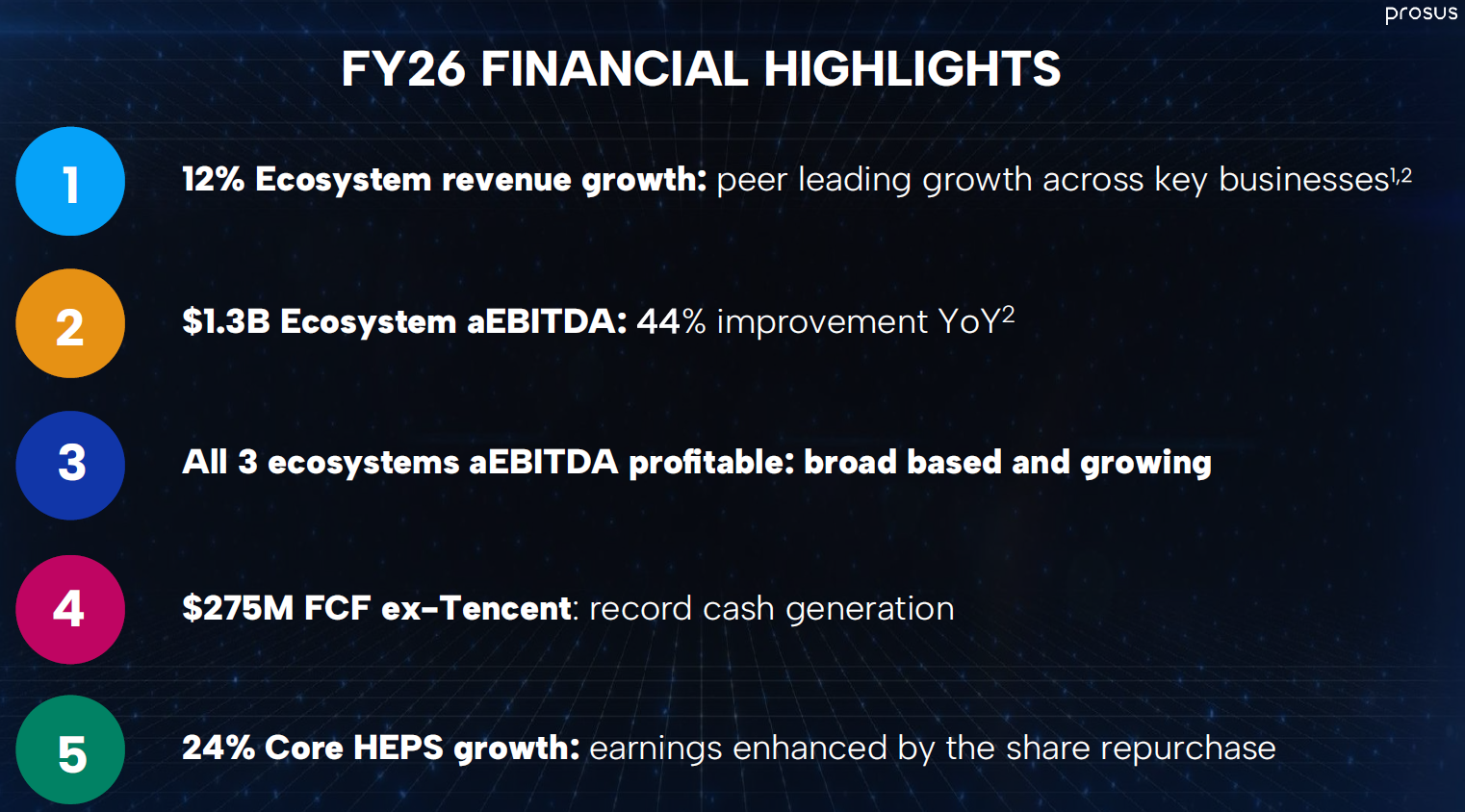
The FY26 results show that the Tencent stake is no longer the sole source of cash flow. The ecosystem itself is now also delivering strong figures. Group revenue rose 12% to $9.7 billion, while adjusted EBITDA (aEBITDA) increased 44% to $1.3 billion, a tripling in just two years. All three ecosystems (Europe, Latin America and India) are now profitable and together generate free cash flow of $275 million. That is a significant improvement compared with 2023, when there was still a loss of $1.16 billion.
However, this profit growth comes with a caveat, namely its concentration. A large part of the ecosystem profit rests on a single holding: OLX. The online classifieds marketplace posted $481 million in aEBITDA at a margin of 48%, making it the most profitable business within the group, well ahead of iFood ($400 million). This adds nuance to the "Prosus +" narrative, as the breadth of profitability is narrower than the slogan suggests. And despite all the progress, Tencent remains by far the most important value creator; the dividend from this stake alone amounted to as much as $1.2 billion this year.
Despite these positive signals, management is asking investors for confidence rather than immediate profit growth for the coming year. When an analyst asked about EBITDA expectations for fiscal year 2027, Bloisi said that this is not a year in which he expects higher profitability. So after a year in which management finally delivered on its promises, it is once again asking investors for trust rather than results.
The explanation for this lies with the two pillars that are meant to carry "Prosus +" forward: Just Eat Takeaway (JET) and iFood. At JET, revenue shrank 4% year-on-year in March 2026. Bloisi did not gloss over this, although he pointed to the improvement compared with the minus 9% seen at the start of this year. Europe head Roberto Gandolfo is pursuing a strategy in which growth comes not from higher service fees but from more orders and retail media. In a handful of test cities, where new AI models (LCM) and a revamped logistics platform are running, revenue is already growing by 25%. The path to structural growth in Europe is expected to be far from easy, and management did not dare to name a firm date in the call for a full return to growth, speaking only of "a few months". Nevertheless, management is optimistic about JET's revenue contribution for the coming year.
At iFood, the pressure comes from outside. New entrants, some of them Chinese, are attacking the market with aggressive subsidies, and according to Latin America head Diego Barreto they are burning through around $150 million a month in doing so, while losing about $8 per order. As a result, Prosus has sharply lowered its EBITDA outlook for 2027. Barreto's reassurance was honest but sobering, because margins will only recover once the irrationality subsides, and that moment lies with the competitor, not with Prosus. Management is choosing to fight the battle through a better product rather than a subsidy war, but in doing so is accepting temporarily lower profitability in one of its most important sources of cash flow.
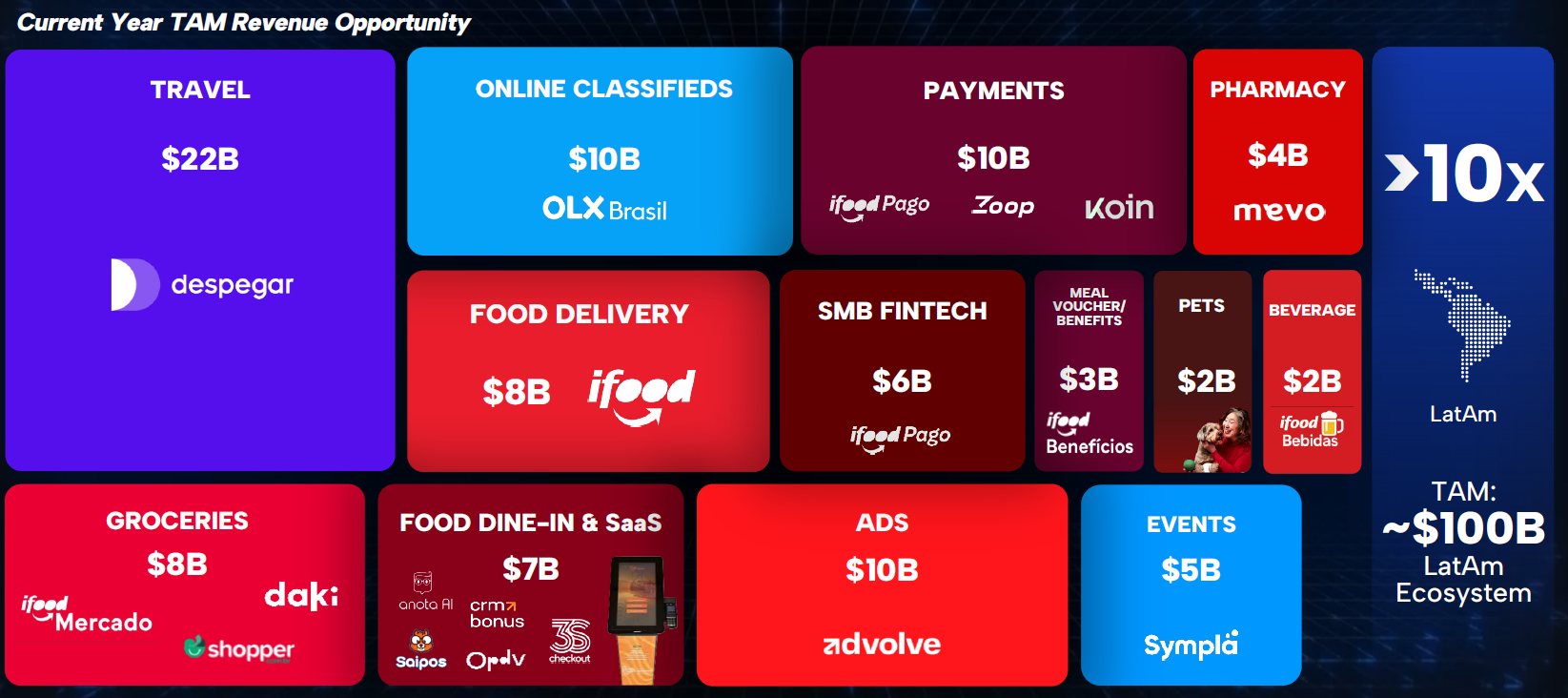
The ecosystem narrative is most convincing when it comes to cross-selling (selling additional services from the portfolio to existing customers). The clearest example can be seen at Despegar. Bloisi notes that since the acquisition, the share of Brazilian revenue generated through the Prosus ecosystem has risen from around 2% to 21%, and that the travel company is currently growing at 30 to 40%, compared with roughly 10% previously. The fact that the company owns several of these types of platforms in different regions and can link them together via its own Large Commerce Model (LCM) is the most tangible proof that the whole can be greater than the sum of its parts. This is where the strategy's real optionality lies.
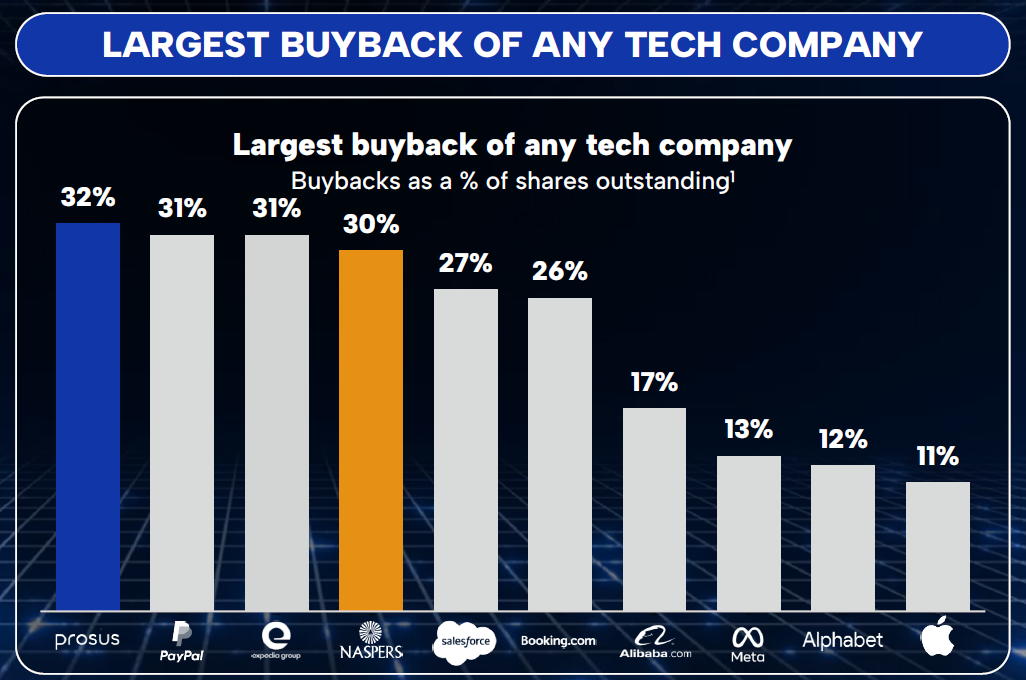
The share buyback remains one of the company's most important instruments. $5 billion is planned for the coming year, bringing the cumulative total since mid-2022 to $46 billion, equivalent to no less than 32% of the freely tradable shares. CFO Nico Marais emphasised during the call that this buyback no longer relies exclusively on the sale of Tencent shares. Management is increasingly financing the programme with proceeds from the sale of non-core assets, such as the stake in Meituan. That is clever, because by needing to liquidate fewer Tencent shares, the relative exposure per share to the Chinese crown jewel increases. When asked whether it would be wise to sell Tencent at the current, depressed price and use the proceeds to buy back its own shares, however, no clear answer was given.
Conclusion
Prosus has by now proven that the cash flow from the ecosystem is not fiction. Yet the composition of that profit calls for nuance. Profitability (ex-Tencent) leans heavily on OLX, a classifieds business that is mainly active in emerging markets. That is precisely the type of online marketplace that has had a hard time on the stock market in recent years, partly because AI is creating cheap alternatives to the search and comparison function that forms the core of these platforms. Prosus is indeed investing heavily in its own AI, but the question remains where these platform businesses will stand a few years from now.
Prosus is doing everything it can to be seen as a fully-fledged tech investor, but so far the contribution of everything outside Tencent has not been particularly material. The cross-selling between the ecosystems is the most interesting part of the story and deserves the benefit of the doubt, but the case management presents assumes an execution that it has yet to largely deliver. The challenge for the coming twelve months is therefore not to prove that "Prosus +" exists, but that it is more than a label on a portfolio that is still, above all, a Tencent stake.
Private equity holding companies invest in AI backbone
The investment holding companies Brookfield (New York: BN) and KKR (New York: KKR) are once again positioning themselves in the renewable energy market this week. The core of these investments is no longer sustainability alone, but the necessity of gaining control over the power supply that will soon literally have to keep the AI revolution running. According to Brookfield CEO Connor Teskey, AI infrastructure and the accompanying hunger for energy is currently the most important theme worldwide, and it is also being treated within Brookfield as the absolute priority at the moment. It has been known for some time that the enormous demand for AI is causing bottlenecks in the infrastructure required for it. Teskey says that access to reliable power is becoming one of the most important competitive advantages, one that weighs at least as heavily as access to capital.
The fact that Brookfield and, as we shall see, KKR too are betting so heavily on (renewable) energy has little to do with idealism and everything to do with cost price. Where five years ago the term energy transition still dominated the conversation, we now find ourselves in an era of energy addition. It is no longer about replacing old sources, but about the massive addition of new energy capacity. The world simply needs more electricity, and the lion's share of that increase is being met by renewable sources, not necessarily because they are clean, but because they are cheap. In that reasoning, the transition is a by-product of the addition, not the goal in itself.
Cheap, however, also has its downsides. Sun and wind do not deliver uninterrupted power, whereas a data centre needs to be able to run 24 hours a day. For these companies, the answer to the question "what does a megawatt-hour cost" is less relevant than the answer to the question "is that megawatt-hour also available at three o'clock in the morning".
In a separate conversation, Arnaud Jouvin, who leads Brookfield's global storage strategy, explained that the appeal of renewable megawatt-hours in the middle of the day is declining to a point where many large off-takers are no longer interested in standalone solar projects. The value no longer lies in the clean megawatt-hour itself, but in the ability to produce power when it is needed most. Hence the shift towards hybrid power purchase agreements (PPAs) that combine generation with battery storage. According to Jouvin, such structures are becoming "the primary way in which we're going to contract our upcoming development pipeline". This hybrid structure ensures that the battery bids in at times when there is a surplus of solar energy, ensures that power can still be delivered when the sun isn't shining, and protects revenue by preventing oversupply.
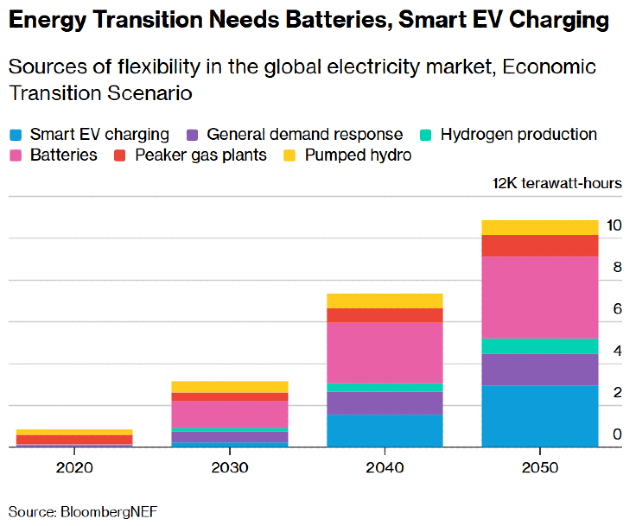
Figures from BloombergNEF underline how structural this shift is. In the research firm's transition scenario, the role of batteries as a source of flexibility in the global electricity grid grows from a marginal position in 2020 to by far the largest category by 2050, well ahead of alternatives such as peaking gas plants, pumped hydro storage and hydrogen production.
Partnership with Bloom Energy
Batteries solve the weather-dependency problem within the existing supply of renewable energy, but they do require a surplus to be available in the first place to store. Bloom Energy (New York: BE) effectively bypasses this dependency on weather and daylight altogether. Through fuel cells, the company supplies electricity that is generated continuously on-site, off-grid, regardless of whether the sun is shining or the wind is blowing. For an AI factory that cannot afford a single moment of downtime, this is not merely an addition to the weather-dependency issue, but a solution that renders the issue largely irrelevant.
This week, Brookfield Asset Management (New York: BAM) raised the framework with which it finances this type of project from the previously announced USD 5 billion to USD 25 billion, a fivefold increase in less than a year. This reflects well the pace and scale of the opportunity within the sector, according to the CEO.
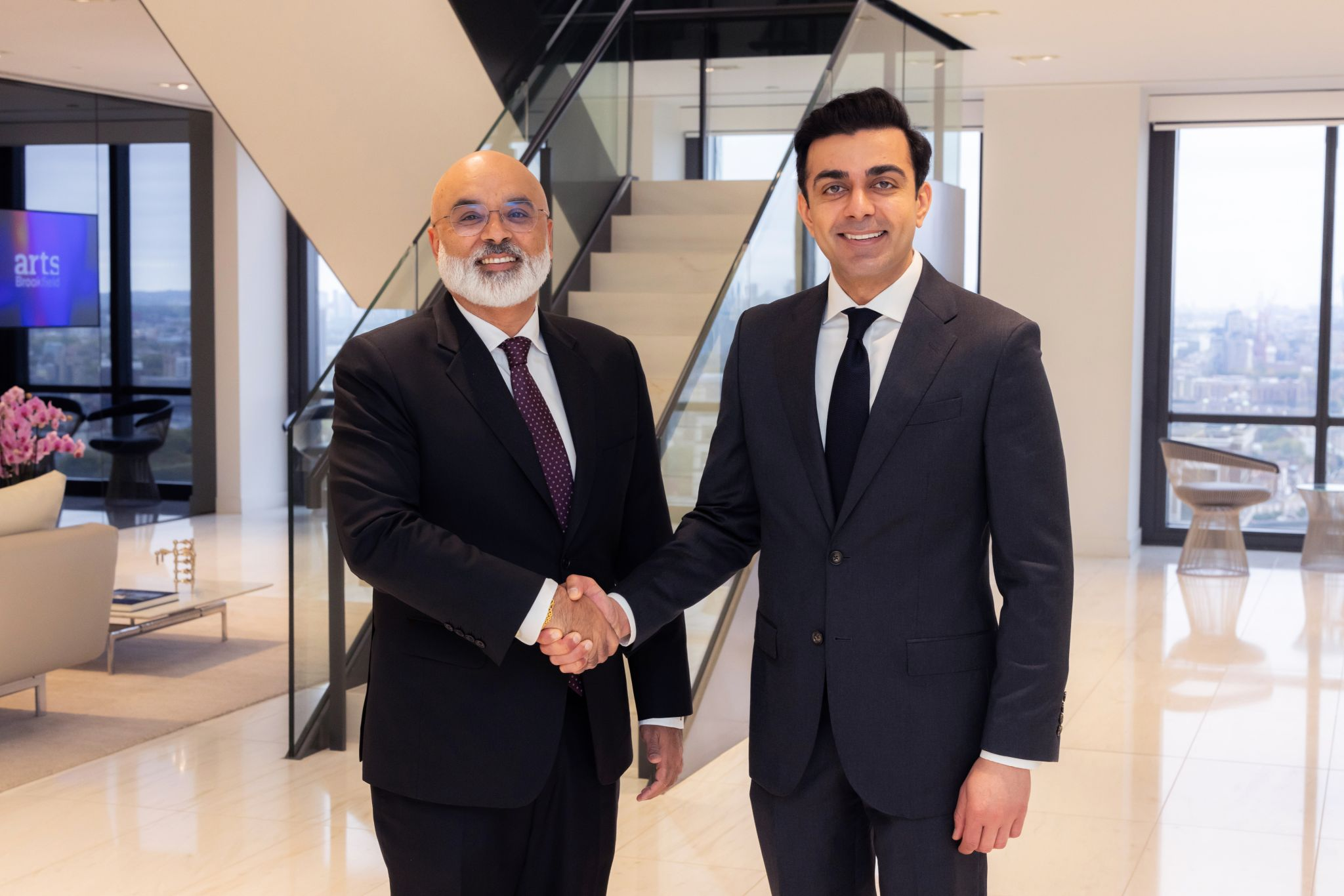
The dynamics of this partnership are strategic for both parties. Brookfield finances the new projects and, in doing so, secures the long-term contracts that guarantee the power off-take. For Bloom Energy, this model offers significant advantages in scaling up more quickly. The company needs to draw on less of its own capital for the rollout, while revenue from Brookfield's investment is booked at an early stage. In effect, Brookfield acts as the well-capitalised partner that bears the risk and financing, while waiting for the stable cash flows from the long-term contracts.
KKR takes a different route in the same direction
Where Brookfield develops and finances projects itself, KKR is opting to acquire platforms that are already operational. This week, the firm reached an agreement to acquire the North American arm of EDF Power Solutions for an equity value of approximately USD 4.2 billion, supplemented by performance-related payments of up to USD 390 million. This acquisition target is among the ten largest owners of renewable energy in the United States and has an integrated platform of solar, wind and battery assets with nearly forty years of operational experience.
Even more concrete is KKR's second transaction, in which the firm is launching a new renewable energy platform together with South Korea's SK Inc. Its value is estimated at 2 trillion won, equivalent to roughly USD 1.3 billion. This will bring together wind, solar and fuel cell assets from various SK subsidiaries. The platform starts with 1.7 gigawatts of operational capacity and aims to scale up to 10 gigawatts. According to the partners, that is enough volume to simultaneously power one hundred large-scale data centres of 100 megawatts each.
In this project, KKR takes operational control, while SK remains a shareholder. Partner Keith Kim describes South Korea as one of the most attractive energy markets in Asia, driven by the hunger for clean power from the local semiconductor, data centre and manufacturing sectors.
Conclusion
Where energy was previously seen as a commoditised cost item, it has now grown into the strategic backbone of the AI economy. The strategy is simple: whoever controls access to energy sources dictates the pace of the digital revolution. For holding companies with permanent capital, owning the entire chain, from electrons to tokens, is the ultimate assurance of stable cash flows. In a world where reliable capacity is the scarcest commodity, these players are emerging as the indispensable architects of physical AI infrastructure.
Receive weekly insights in your inbox
Exclusive analyses and updates on family holding companies and global market developments.
What's next for Scottish Mortgage?
SpaceX's listing was a milestone in more ways than one for the British holding company Scottish Mortgage Trust (London: SMT). The trust's largest position was valued at around $1.8 trillion at listing, moving it in one go from the private to the public part of the portfolio. For investors, this produces an interesting side effect: the allocation to unlisted companies, which had risen well above the internal ceiling of 30% in recent months as SpaceX surged, dropped back below that threshold in a single day. Now that headroom has returned, manager Tom Slater can once again make full use of new opportunities in the private sphere.
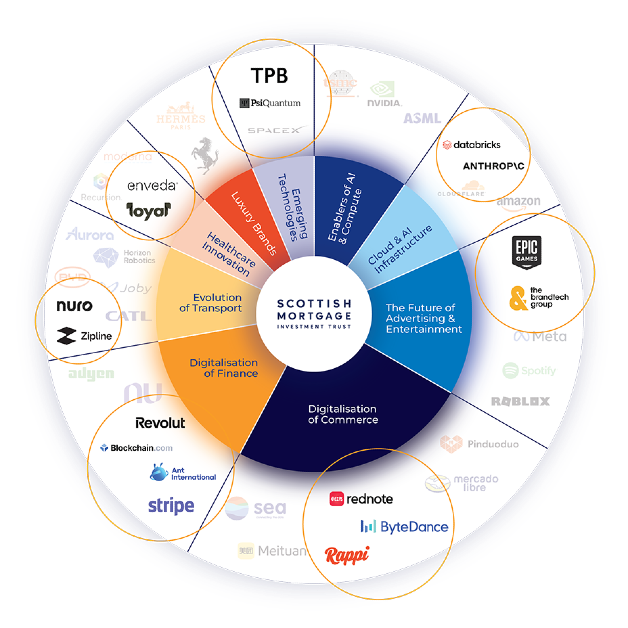
Although SpaceX has unmistakably commanded attention in recent times, it is certainly not the only private holding within Scottish Mortgage's portfolio. Beneath the surface lies a wealth of growth companies that are normally out of reach for the ordinary investor. It holds a broad collection of companies making significant strides, ranging from AI systems and payment networks to digital banks and groundbreaking methods of drug development. Names such as Anthropic, Databricks, Stripe, ByteDance and Revolut together represent trillions in private market value, and behind them lies a long line of further companies that remain out of reach for the average equity investor.
In a recent interview, Slater explains where he expects returns to come from. His search for companies with what he calls "supernormal" potential remains the starting point. He always asks himself the same question: "If everything goes right, how much can you make?" According to Slater, the price always turns out, in hindsight, to have been unreasonable: too cheap for the winners and too expensive for the losers. As long as investors remain willing to pay those high prices for the eventual winners, he does not consider the market to be overpriced by definition. In that sense, every price is unreasonable according to Slater, not because the market is necessarily too expensive, but because a price simply cannot correctly capture such a skewed outcome. With every purchase, you essentially accept that you are paying a price today that looks insane, knowing that for the true winners it will later prove to have been a bargain. As long as investors remain willing to pay those high prices, he therefore does not consider the market to be overpriced by definition.
He qualifies this view on valuations by looking at today's AI technology companies. Although they are no longer as cheap as they were three years ago, he points to Meta as an example to show why there is likely still plenty of room left to run. Meta reaches an enormous scale with roughly three billion daily users, but adds relatively little economic value per user. Slater therefore openly wonders what becomes possible once that same distribution is combined with genuinely economically valuable output: "If you can already grow to around $1.5 trillion in market value with such 'frivolous use cases', that forces you to think about how big a company can become once the output is actually economically valuable." In that light, he still considers Nvidia reasonably priced, especially given a price-earnings ratio in the twenties for the largest company in the world.
Despite his optimism, Slater is not blind to the risks that come with such growth. He sees pockets where euphoria has run too far ahead, and knows that obstacles around power supply, chip shortages or geopolitics can leave individual companies vulnerable. Still, he remains positive as long as the underlying technology delivers economic progress and efficiency.
Investor AB defence subsidiary Saab overwhelmed with orders
The Swedish holding company Investor AB (Stockholm: INVE-B) owns 29% of defence giant Saab AB. With a share price surge of almost 900% (excluding dividend) over five years, this has certainly not been a bad deal for the family holding company. Last week too, Saab was in the spotlight with several (potential) sizeable orders, driving yet another share price jump of 15%.
The largest signed order came from Poland on Monday. Saab will deliver three A26-type submarines to the Polish navy for SEK 47 billion (approximately USD 4.8 billion), including weapons, training and long-term support. Deliveries will continue until 2038, making this one of the largest European naval orders of recent years. Poland already chose the A26 design last year as part of a broad modernisation of its armed forces, aimed at deterrence in the Baltic Sea. The country is now among the NATO member states with the highest defence spending relative to the size of its economy.

A day later, Ukraine followed. Saab signed a contract for the delivery of sixteen new Gripen fighter jets worth SEK 24.6 billion (approximately USD 2.5 billion), including spare parts, related equipment and technical support. The aircraft will be delivered in 2029 and 2030. The contract stems from the air defence cooperation agreement signed last year by Swedish Prime Minister Ulf Kristersson and Ukrainian President Volodymyr Zelensky, which includes the possibility of exporting 100 to 150 Gripens to Ukraine over time. Training of Ukrainian pilots and technicians has already started in Sweden. In addition, Sweden is donating sixteen older Gripens from its own fleet, the first of which will be handed over in early 2027. Combined, Saab added roughly USD 7.4 billion in new orders to its order book within a matter of days.
However, the potentially biggest news came later in the week. News agency Reuters reported on Thursday, citing four sources, that NATO wants to replace its ageing fleet of fourteen AWACS reconnaissance aircraft with Saab's GlobalEye. The announcement is expected at the NATO summit in Ankara on 7 and 8 July. A spokesperson for the alliance confirmed that a decision on the replacement will be announced at the summit, but gave no details. Saab declined to comment.
 Michael Gielkens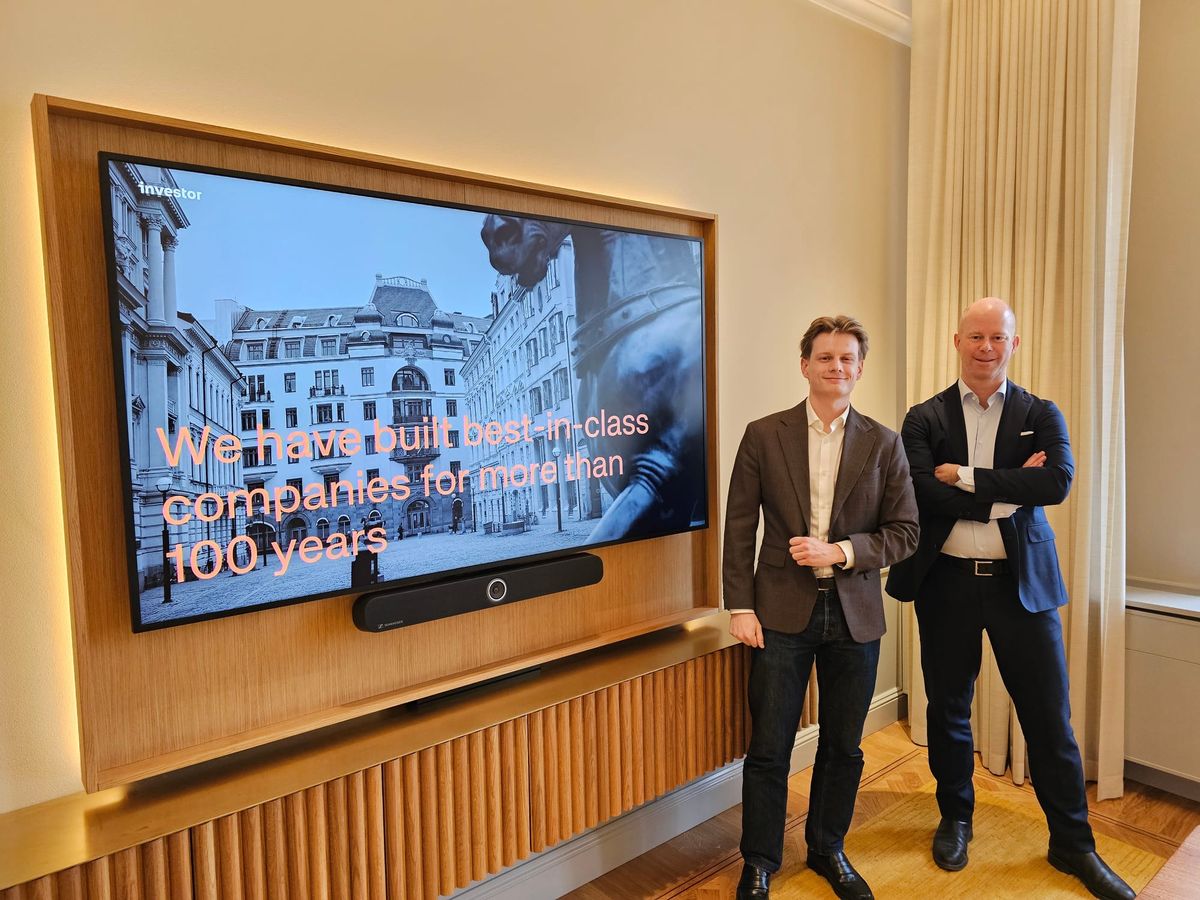
The AWACS fleet, recognisable by its nine-metre-wide radar dome, has served as the alliance's flying radar post since 1982. The aircraft are among the few military assets NATO owns itself, are crewed by personnel from 21 of the 32 member states, and have played a key role in reconnaissance missions along the eastern flank since the outbreak of the war in Ukraine. They are stationed at Geilenkirchen air base, a familiar name to people from Limburg, just across the German border near Brunssum. Under the replacement plan, Geilenkirchen could grow into the home base of the largest GlobalEye fleet in the world.
The GlobalEye, built on the Global 6500 business jet platform from Canada's Bombardier and in service since 2018, detects and tracks threats in the air, on land and at sea. The aircraft competes with Boeing's E-7 Wedgetail, which is based on the 737. NATO abandoned the purchase of six Wedgetails in 2025 after the Pentagon scrapped its own order for 26 aircraft in favour of satellite capacity. A few weeks ago, Canada ordered six GlobalEyes, so far the largest order for the aircraft; NATO's order is expected to be larger. The final number may depend on the choice of a more expensive variant capable of in-flight refuelling, a capability the current AWACS fleet does possess and which has proven valuable during missions near Ukraine. Politically, the choice is sensitive, as President Donald Trump is urging European allies to buy more American defence equipment.
Receive weekly insights in your inbox
Exclusive analyses and updates on family holding companies and global market developments.
Would you like more information about our services?
Get in touch
Disclaimer:
No rights can be derived from this publication. This is a publication of Tresor Capital. Reproduction of this document, or parts of it, by third parties is only permitted after written consent and with reference to the source, Tresor Capital.
This publication has been compiled by Tresor Capital with the greatest possible care. The information is intended in a general sense and is not tailored to your individual situation. The information should therefore explicitly not be regarded as advice, an offer or a proposal to purchase or trade investment products and/or to obtain investment services, nor as investment advice. The authors, Tresor Capital and/or its employees may hold positions in the securities discussed, for their own account or on behalf of their clients.
You should carefully consider the risks before you start investing. The value of your investments may fluctuate. Past performance offers no guarantee for the future. You may lose (part of) your invested capital. Tresor Capital disclaims any form of liability for any inaccuracies or errors. This information is indicative only and subject to change.
Read the full disclaimer at tresorcapitalnieuws.nl/disclaimer .
This article was translated automatically from Dutch using AI. In case of any difference, the Dutch original prevails. Read the original in Dutch.