Family Holdings #30 - Recovery and growth of the fundamentals


This week's topics:
The half-year results of 3i Group show that, thanks to excellent operational performance, the holding company's NAV per share rose, with a total return of 3% over the quarter, despite negative currency effects. The increase in value is mainly driven by discount chain Action, which is showing a strong recovery with revenue up 14% to €8.35 billion and like-for-like growth that accelerated sharply in later weeks thanks to favourable summer weather. The EBITDA margin remained stable at 13.3%, while recent price comparison research confirms that Action is effortlessly maintaining its razor-sharp price advantage of almost 50% on average versus competitors.
Alphabet posted strong Q2 figures, with revenue up 24% to USD 119.8 billion and operating profit of USD 40.8 billion. However, the bottom-line result was clouded by USD 98 billion in unrealised revaluations (SpaceX & Anthropic), causing adjusted earnings per share to come in slightly below expectations. Google Cloud excelled with 82% revenue growth, an operating margin of more than 35% and a record backlog of USD 514 billion. Search grew by 17% to USD 63.3 billion, but is facing criticism over declining classic volume and more expensive, lower-quality clicks. With CapEx guidance raised to USD 195–205 billion, free cash flow dipped into negative territory.
Sofina has, for the first time in its recent newsletter, given insight into the underlying holdings within Sofina Private Funds, with prominent names such as Anduril, OpenAI, Anthropic and SpaceX together representing around 10% of the portfolio. While the weight of private funds rose to 49% of net asset value, the balance sheet shows that this growth has largely been driven by capital calls and deployed liquidity rather than spectacular upward revaluations. At the same time, the holding company is facing a challenging exit environment for mature companies, and a broader decline in trading activity on the Brussels stock exchange is weighing on the shares, resulting in a persistent discount to net asset value of around 27%.
In Brief:
Asseco Poland (Warsaw: ACP) has secured a place with its voice assistant Pola.ai in the "Best products for large enterprises 2026" overview compiled by the Polish newspaper Gazeta Finansowa. Pola.ai automates customer contact by combining speech recognition, large language models and speech synthesis, supports up to 120 languages and is available as an on-premise solution or as SaaS. The recognition shows that, alongside bespoke solutions for banks and governments, Asseco is also successfully bringing its own AI products to market for large enterprises.
Addtech (Stockholm: ADDT-B) saw an insider purchase by Michael Ullskog, head of Automation. On 17 July, he bought 3,400 shares at a price of SEK 342.65 each, a total amount of almost EUR 105,000.
Brookfield (New York: BN) is acquiring battery storage developer Aypa Power from Blackstone for approximately USD 7 billion in enterprise value, or USD 3 billion in equity value. Aypa is the largest independent battery storage developer in North America, with around 6.5 gigawatts of operational and contracted capacity and a development pipeline of more than 20 gigawatts. The acquisition gives Brookfield scale access to the North American battery storage market, which is benefiting from growing power demand from AI data centres and electrification.
Scottish Mortgage (London: SMT) looked back in a video update on the second quarter, in which SpaceX's stock market listing took centre stage. The trust invested as a private shareholder in 2018 with a stake of around USD 200 million; that holding is now worth approximately USD 5 billion, a return of 25 times the original investment. At the end of June, SpaceX represented more than 25% of the portfolio. Once lock-up restrictions expire, the managers expect that weighting to decrease, although the position will remain substantial. At the same time, the investment in Tesla came to an end after 13 years. The managers believe investors are paying too much for its still-nascent activities in autonomy and robotics. The original investment of around USD 470 million generated approximately USD 6.2 billion in realised profit, around 13 times the original investment. The capital freed up is flowing, among other things, into chipmaker SK Hynix and into two new energy positions, power producer Vistra and gas producer EQT, as the managers see electricity as the next bottleneck in the rollout of AI. In addition, the trust took part in Anthropic's recent funding round.
Heatwave puts Action into a higher gear
The recent quarterly update from 3i Group (London: III) covering the first six months of 2026 shows that Action is making an impressive catch-up in growth. Thanks to this sustained operational strength, the net asset value (NAV) per share of parent company 3i Group rose in the first quarter of the broken financial year to GBP 31.31 as at 30 June 2026 (versus GBP 30.30 as at 31 March 2026), representing a total return of more than 3% despite a negative currency effect of GBP 0.27 per share. On the operational side, although the first half of 2025 was the toughest comparison base of that year, Action still managed to grow revenue by 14% to EUR 8.35 billion. Operating EBITDA also rose as a result, up 13% to EUR 1.11 billion.
Organic growth
Taking a closer look at the store performance itself, we see that this strong trend translates into like-for-like sales growth (growth in the same stores) of 3.6% over the entire half-year, primarily driven by an increase in the number of customer transactions. If you zoom in on how the year progressed, you can see a clear acceleration compared with the first 19 weeks, when LFL growth still stood at 2.4% on an annualised basis. Looking at the subsequent period up to and including week 25, this figure had already climbed to 3.3%. Analyst Massive Moats dug deeper into the figures on X to estimate roughly how fast growth had been running in the intervening periods.
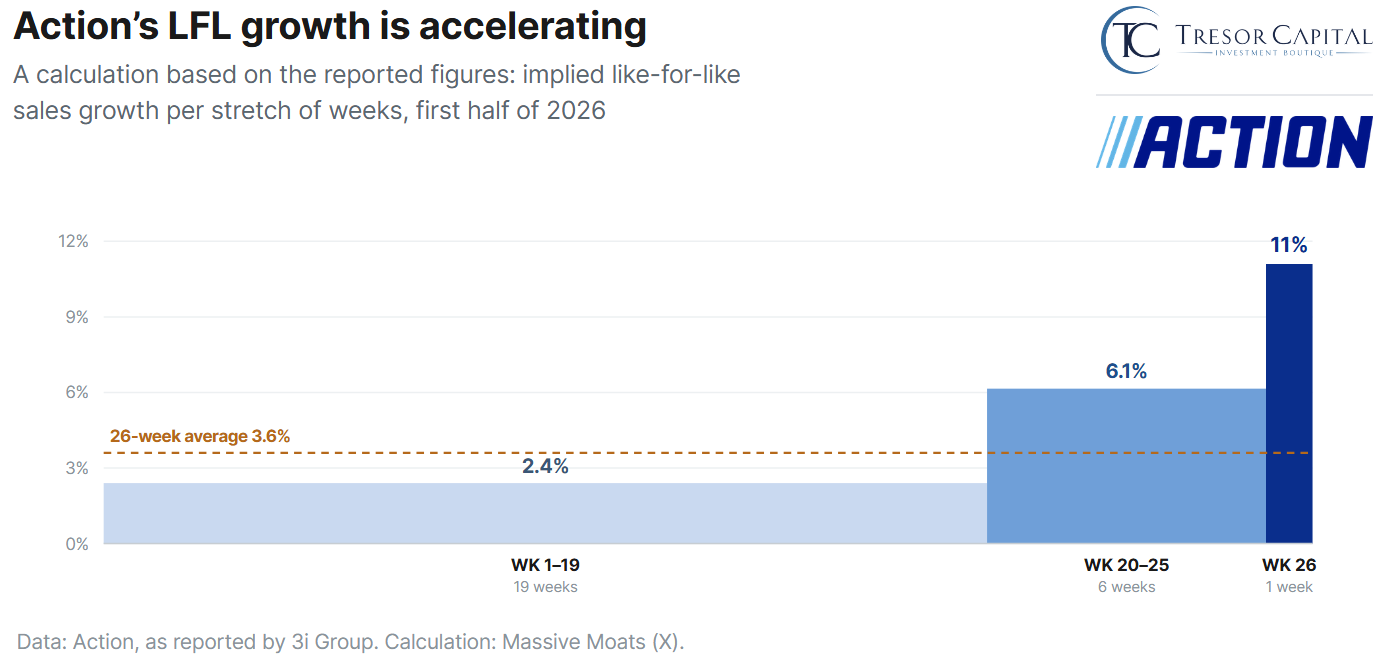
Over the six weeks between week 20 and 25, LFL growth had already risen to around 6.1%, but the real outlier came in period P6, or week 26, which ended on 28 June. That single final week reportedly saw exceptionally high LFL growth of around 11% on an annualised basis. Massive Moats calculates that the comparison over the most recent weeks (week 20 through 26) received a boost of roughly 80 basis points as a result.
Behind this spectacular growth acceleration in the later weeks lies an interesting dynamic closely linked to weather conditions in Europe. Action's management regularly points out in its results discussions how strongly weather can affect sales of seasonal products; in the past, disappointing results have sometimes been attributed to extreme cold making it difficult to keep stores stocked, or to a summer that failed to materialise. The acceleration in sales outlined here is therefore likely driven largely by the fact that the long-awaited heatwaves in Europe finally arrived.
To capture this fickle weather effect in a light-hearted way, we have put together our own scale below:
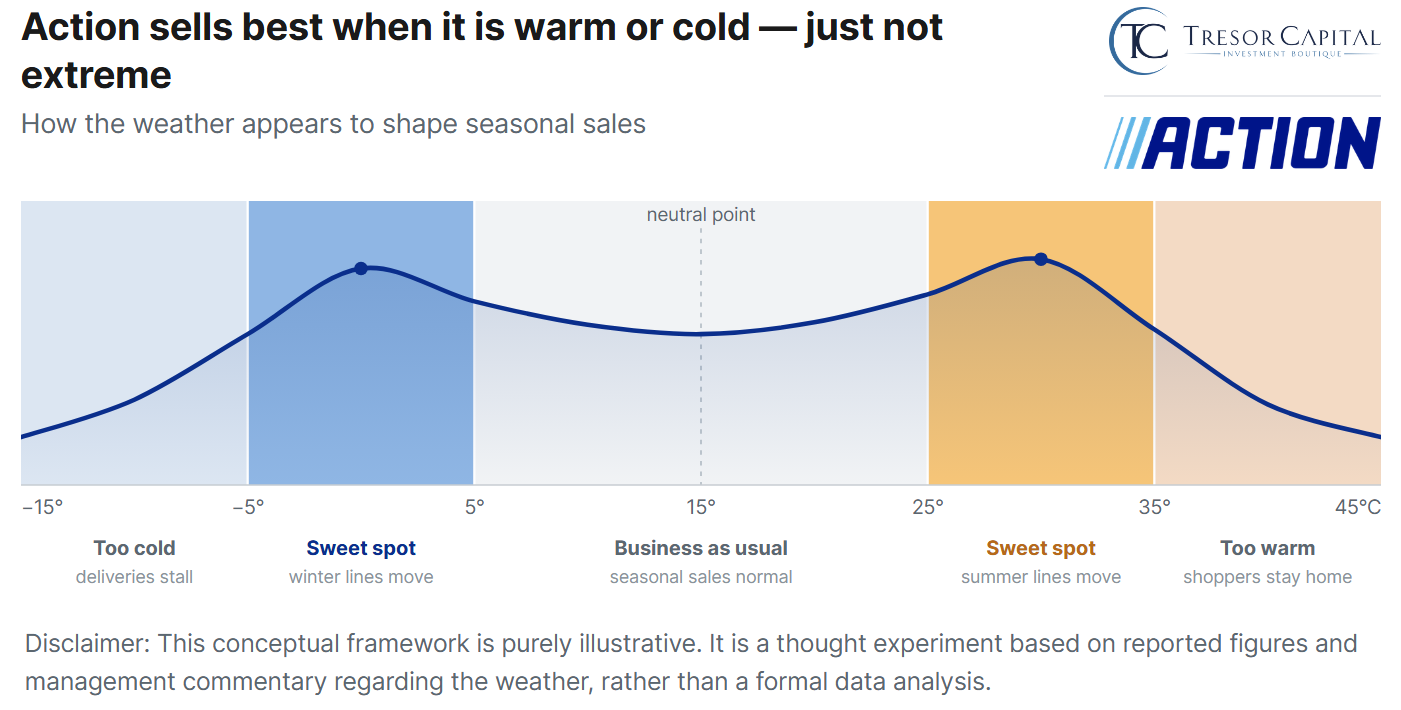
- Business as usual (5°C and 25°C): At these temperatures, seasonal sales run steadily and as expected.
- The sweet spot (between 25 and 35°C and between -5 and 5°C): These are the optimal conditions, where it is either quite warm or fairly cold, but not yet too extreme. Consumers flock to shop for paddling pools, fans, or winter gear, causing seasonal sales to peak here.
- The extreme (anything above or below that): Too hot or too cold hurts on both sides. Extreme weather conditions disrupt both physical footfall and logistics, which directly weighs on results.
Margins and prices
Over the first six months of 2026, Action's operating EBITDA margin came in at 13.3%, exactly in line with the same period last year. This is a reassuring signal, given that we had previously wondered whether this margin could hold up. Geopolitical tensions and the shift towards more direct sourcing could, after all, bring additional costs in the short term. Although concerns about the margin are therefore certainly not entirely off the table (in the second half of the year, the margin will need to recover from the current 13.3%, just as it did in 2025), the direction is positive. Over the longer term, direct sourcing should structurally result in lower costs and/or better product quality.
The fact that Action can maintain this razor-sharp pricing is underscored by a recent price comparison study by the Murray Wealth Group. Using AI, the study compared the prices of 250 everyday products, such as food, toiletries, cleaning products and household items, between Action and competitors in the Netherlands, Germany, France, Poland and Italy.
The results are impressive:
- An average of 48% cheaper: A shopping basket costing roughly 100 euros elsewhere costs about 52 euros at Action.
- Extreme consistency: Action had the very lowest price on 249 of the 250 products, with 90% of those products priced at least 30% below competitors.
- Standouts: The biggest savings ran as high as 55% to 60% in categories such as home décor, batteries and kitchenware, while savings on food, at just over 30%, were somewhat smaller but still meaningful.
- Differences by country: The advantage ranged from around 43% in fiercely competitive Germany to more than 50% in the Netherlands.
All of this proves that operational strategy and purchasing power directly contribute to the company's strong market position.
The cloud shines at Alphabet, but CapEx spooks investors
There was little suspense beforehand about what the results of the American technology holding company Alphabet (New York: GOOGL) would revolve around. The persistent price increases for memory chips made an upward revision of capital expenditure almost a foregone conclusion. Nevertheless, the market reacted sharply. During the earnings call, the share initially remained flat in after-hours trading, but the moment CFO Anat Ashkenazi mentioned the new range, the share dropped a few percentage points. The geopolitical escalation surrounding Iran this week also caused pronounced down days.
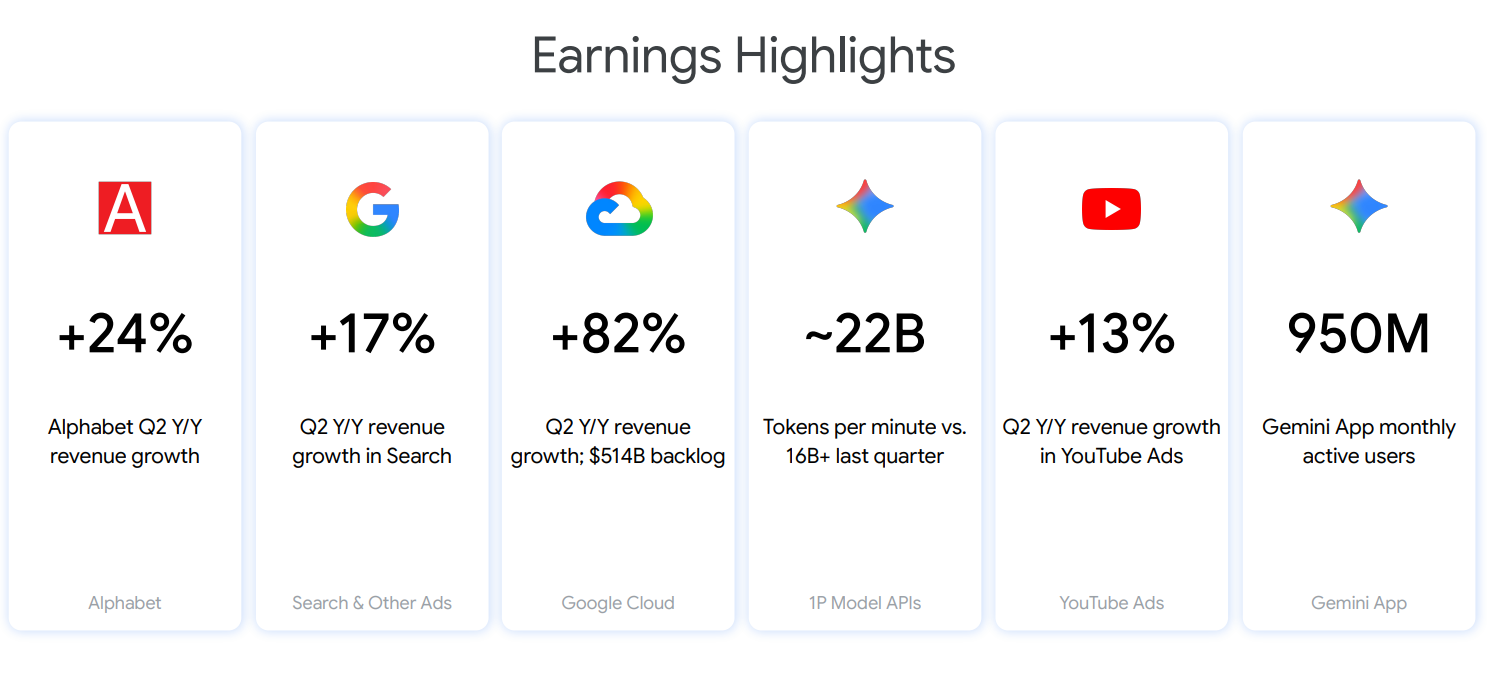
The results themselves were strong on almost every front. Revenue rose by 24% to USD 119.8 billion and operating profit increased by 30% to USD 40.8 billion at a margin of 34%. However, the bottom line was significantly clouded by an item of USD 98 billion in other income and expenses, almost entirely attributable to unrealised revaluations in the equity portfolio, with SpaceX as the standout. As a result, the reported earnings per share of USD 9.11 is not a useful metric; adjusted for this effect, around USD 2.85 remains, against an expectation of USD 2.90, which amounts to a slight miss.
The search engine
Revenue from the search engine came in at USD 63.3 billion, growth of 17% that is regarded as disappointing in the current market climate, because it was exactly in line with consensus. More interesting than the growth figure itself is the change in its composition. There is criticism circulating from large advertisers that classic search volume is declining as queries that users pose directly to AI chatbots are taking over traffic. Google is said to be compensating for this through more expensive, lower-quality clicks, by linking advertisements more broadly to search terms that only loosely resemble the keywords advertisers are paying for, and also by using its automated auction systems to drive up the price per click.
As someone who has personally spent $500k / mo+ on Google Ads for years, I can tell you with certainty:
— Max Anderson (@MaxAnderson) July 23, 2026
This revenue growth in Search is artificial & extremely unhealthy for Google’s business long term
Search volumes are declining as legacy search is being increasingly… https://t.co/PsWOjV76nF
Management confirms that Gemini is helping to attach advertisements to longer, harder-to-monetise search queries. However, the figures from the quarterly report qualify the fear of sky-high prices: in the second quarter, paid clicks rose by 13%, while the average price per click increased by only 3%. Growth has thus clearly become volume-driven, as a larger share of search queries is being monetised. Whether these incremental clicks are valuable to advertisers will have to become clear from their returns; if advertisers see less revenue per euro spent on advertising, budgets risk draining away. Moreover, Search benefited this quarter from a one-off boost from the football World Cup, and Ashkenazi warned that the third quarter will face a tougher comparison base and currency headwinds.
Cloud as the star of the show
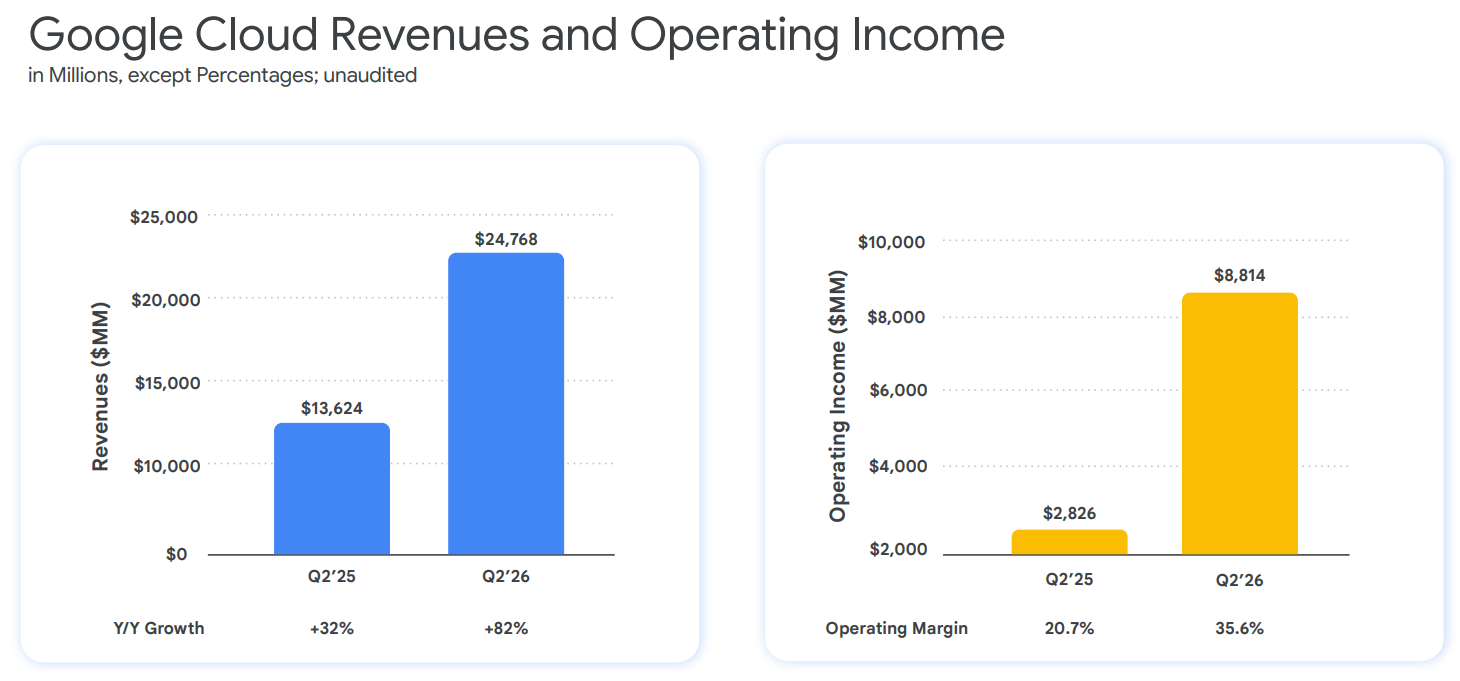
Google Cloud was the undisputed star of the quarter, with revenue growth of 82% to USD 24.8 billion. Operating profit tripled to USD 8.8 billion and the margin jumped from 20.7% to 35.6%. The order book rose by more than USD 50 billion compared with the previous quarter to USD 514 billion, of which Alphabet expects to recognise half as revenue within 24 months. If we project this onto the rest of 2026 (the coming six months in the second half of the year), this means that more than USD 257+ billion in backlog revenue to be recognised will be booked over the next two years. Spread evenly over this 24-month period, this amounts to a pace of roughly USD 10.7+ billion per month, underscoring the solid contractual base that will contribute to revenue going forward.
CFO Anat Ashkenazi emphasised that this strong margin expansion and growth are related to a persistently tight market for capacity. To keep meeting the enormous demand, Google is temporarily relying more on external capacity in Q3 as a bridging strategy (think, for example, of renting data centre capacity from SpaceX); although this puts some pressure on Cloud's operating margins in the short term, it is crucial to sustaining the strong commercial momentum.
Despite these figures, there is fundamental pressure on the share due to the performance of the Gemini model, which is currently falling behind competitors such as OpenAI and Anthropic on leading benchmarks. This raises doubts about the effectiveness of the massive investments. Management counters this by shifting the focus to the cloud layer: Pichai emphasised that the language model is merely one ingredient of a broader solution and that Alphabet also offers third-party models if desired. Customers purely seeking hardware are kept at arm's length, and behind the temporary margin pressure (from external capacity and the Wiz integration) lies a deliberate strategy to secure multi-year relationships.
Negative cash flow
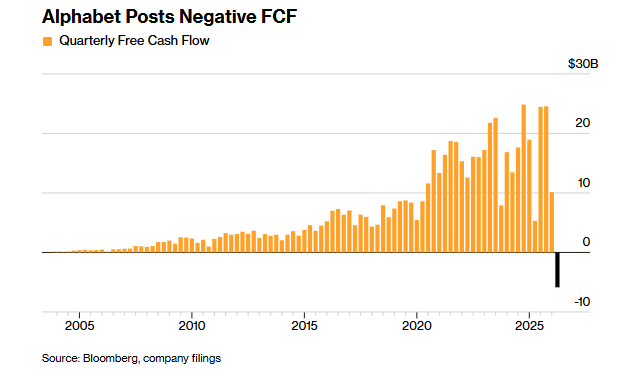
This shifts the real debate about Alphabet from operational performance to capital allocation. Free cash flow plunged into negative territory due to massive investment, falling to minus USD 5.9 billion for the quarter, and on a trailing twelve-month basis it declined from USD 64.4 billion to USD 53.3 billion. Because the annual CapEx guidance has been raised to a range of USD 195 to 205 billion, free cash flow is set to remain under heavy pressure. To finance this, outstanding debt has risen to around USD 100 billion in a short space of time, and shares have been issued, whereas historically the company has bought back its own shares.
As a result, return on invested capital (ROIC) is now coming under direct scrutiny. Because of the enormous investments, ROIC has fallen to around 18%. Although part of this decline is mechanical, since the completion of data centres and the resulting revenues only materialise after several years, the coming period will be all about the inflection point. As long as cash flow from the search engine remains strong, the market will accept this aggressive strategy. But if the Cloud division fails to sustain its high margins once CapEx rises again in 2027, the debate among investors about this investment programme of more than USD 200 billion a year will quickly shift from patience to a demand for stricter discipline.
Conclusion
Alphabet finds itself at a crucial crossroads, where the tremendous strength of the core business and the explosive expansion of Google Cloud collide with astronomical investment commitments. It is important to remember that these investments are necessary in order to survive in the current climate. This leaves the market weighing an interesting trade-off: should AI generate less return than expected, Alphabet can fall back on the enormous profits from its existing operations to absorb the investments; but should it perform better than expected, the company has an unrivalled infrastructure at its disposal to apply this and reap the full benefits. As long as the company's profits can absorb the greater part of the gigantic CapEx peak of over USD 200 billion, the growth story remains intact. However, should the operating leverage falter once investments increase further in 2027, investors' patience will quickly give way to hard questions about the return on invested capital.
Receive weekly insights in your inbox
Exclusive analyses and updates on family holding companies and global market developments.
Sofina's cautious transparency on top exposure in the private market
On Wednesday evening, the Belgian family holding company Sofina (Brussels: SOF) published newsletter number 18. For the first time, it contained something the market has been angling for for years: clarity on the underlying companies to which the holding company is exposed via third-party funds within Sofina Private Funds. The preliminary estimate of net asset value came in at EUR 319 per share at the end of June, up 4.3% compared with the end of 2025. The list of names is interesting, featuring crowd-pleasers such as Anduril, Anthropic, Databricks, OpenAI, SpaceX and Stripe. Together, the ten largest indirect holdings represent around 10% of the net asset value of the total portfolio on a look-through basis.
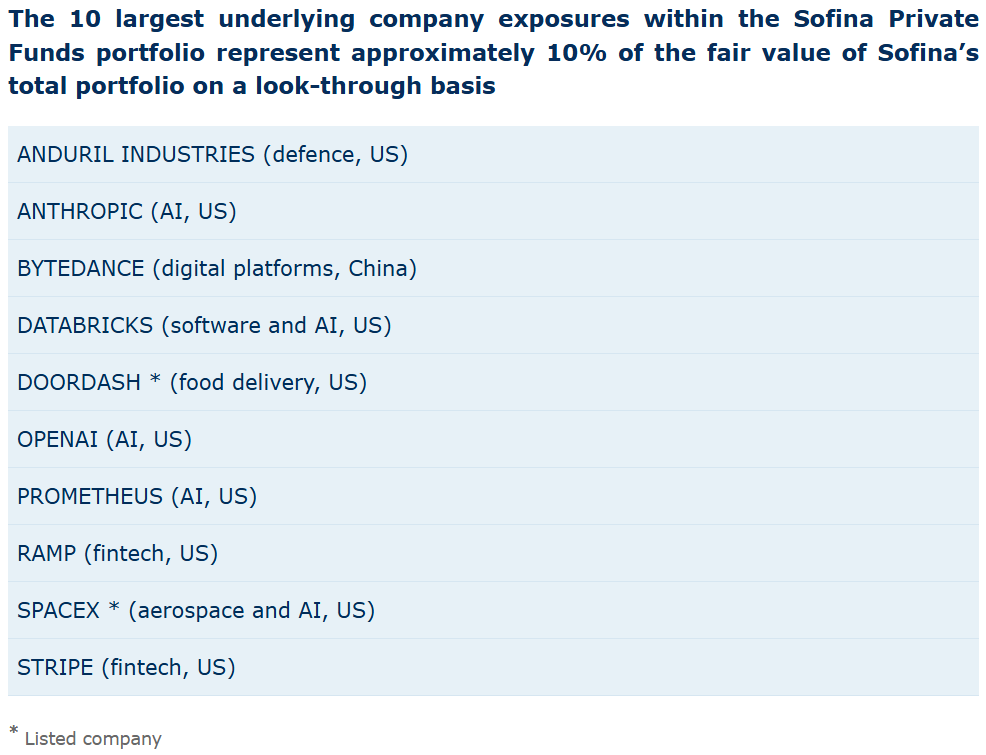
The ten names are listed alphabetically and therefore say nothing about their relative size. CEO Harold Boël attributes this to differing valuation dates and reporting delays among the fund managers, although the half-year report in September is promised to include a ranking from largest to smallest. Moreover, the top ten is based on outdated reports going back as far as the end of last year, with hardly any corrections applied. In a market where AI valuations double within months, these figures may deviate materially from the current reality. This transparency should therefore be seen mainly as an indication of economic exposure rather than a homogeneous valuation.

What we do know is that the weight of Sofina's private portfolio has risen sharply over the past six months. Sofina Private Funds grew from EUR 4.9 billion to EUR 5.7 billion and now accounts for 49% of the total, compared with 46% at the end of 2025. By contrast, long-term minority investments declined (from 28% to 25% of NAV), while Sofina Growth's share remained relatively stable at 26%. Here too, it is difficult to distinguish how much of this shift represents genuine value creation and how much is simply newly deployed capital.
The balance sheet, however, offers a clear clue: gross cash fell from EUR 1.7 billion to EUR 1.1 billion, while debt remained unchanged at EUR 1.3 billion. Sofina has thus drawn on around EUR 0.6 billion of net liquidity, and since Harold Boël confirms that 2026 is on track to be the most active year ever in terms of fund commitments, the growth of the funds bucket can largely be explained by capital calls and probably not so much by spectacular revaluations.
Harold Boël was a guest at our relations day on 1 April, where he set out the family holding company's long-term vision. You can read a report on that day via the link below:
 Michael Gielkens
Sofina Direct
Within Sofina Direct, ByteDance remains number one, followed by Cambridge Associates and Proeduca. The ten largest direct holdings together account for 27% of the portfolio on a look-through basis, down from 29% at the end of 2025. The ranking itself has been shuffled considerably. Cambridge Associates climbed from sixth to second place and Proeduca from fifth to third, while Cognita dropped four places from second to sixth. Salto Systems remained ninth, pending the sale signed after the half-year. At the bottom of the list, EG Software dropped out and Cleo AI appeared as a new entrant in tenth place.
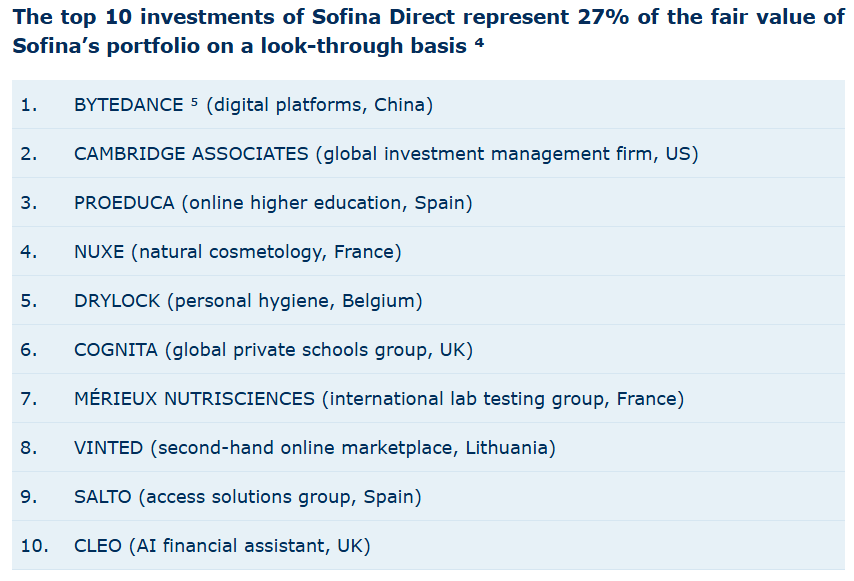
Boël only explains these shifts in general terms. He speaks of a mixed picture, in which a number of positions have changed due to various factors: underlying growth, market turbulence and adjustments to valuation multiples. As headwinds, he explicitly cites the ongoing crisis in the Middle East and pressure on discretionary spending in developed economies, without naming specific companies. On the early stage side, it's a party, with AI mega-rounds and IPOs on the horizon; among more mature companies, financial buyers are holding back because they still lack clarity on the impact of AI on established business models. Boël candidly acknowledges that the exit climate for mature companies is not the easiest it has ever been. As a result, Sofina has to monetise in a tougher market rather than truly being able to reap the rewards.
The discount
The fact that the market is responding to all this uncertainty with a hefty discount of around 27% to net asset value is understandable in itself, but it is being amplified by a broader dynamic entirely unrelated to the underlying portfolio. Figures from Euronext show that the number of stock exchange transactions in Sofina fell by 18% in the first half of the year. This fits into a broader downward trend on the Brussels stock exchange, where trading is under pressure due in part to tax changes such as the introduction of the capital gains tax. Retail investors are massively swapping individual shares for funds, turning an illiquid home market into a challenging environment.
For Sofina itself, this shrinking free float is not, for the time being, a direct cause for concern; after all, the holding company has recently raised a considerable amount of capital and holds ample reserves to finance its ambitious fund commitments. Only if payouts from the portfolio were to disappoint for a prolonged period and fresh capital were unexpectedly required would an illiquid home base really start to pinch. Even so, the market is not entirely indifferent to the issue, as thinner trading could, over time, contribute to a more persistent holding company discount.
Conclusion
The additional transparency in the newsletter is a first step in the right direction. That list of underlying holdings offers an enormously interesting exposure to the absolute top tier of the private market, featuring heavyweights to which you, as an investor, would normally get little to no exposure. As investors, we naturally always hope for greater openness, something that has traditionally not been very much in Sofina's nature, but in that respect it is somewhat disappointing that the exact weightings of the top 10 positions are missing. Because of the absence of those weightings, the valuation remains, for now, something of a guessing game.
MBB raises profit outlook after a strong first half
The German family holding company MBB SE (Frankfurt: MBB) and its listed subsidiary Friedrich Vorwerk presented their preliminary half-year figures this week, in which they raised their profit outlook for 2026. MBB is a textbook example of skin in the game. Founder and chairman Christof Nesemeier and co-founder Gert-Maria Freimuth together control a majority of the shares and recently bought more shares for over EUR 750,000 at a price of around EUR 167 per share.
The results for the first six months show stable revenue combined with a sharply rising profit. Group revenue fell slightly by 1.7% to EUR 536 million, while operating profit (EBITDA) rose by 53.3% to EUR 117.1 million. In the second quarter, this profit measure even increased by 61.8% to EUR 75.2 million. As a result, the margin rose to 25.1%, which is 8.7 percentage points higher than in the same period last year. This impressive result is the direct consequence of a more favourable product mix. As shown in the chart below, the EBITDA margin has thus risen by more than 18 percentage points over three years.
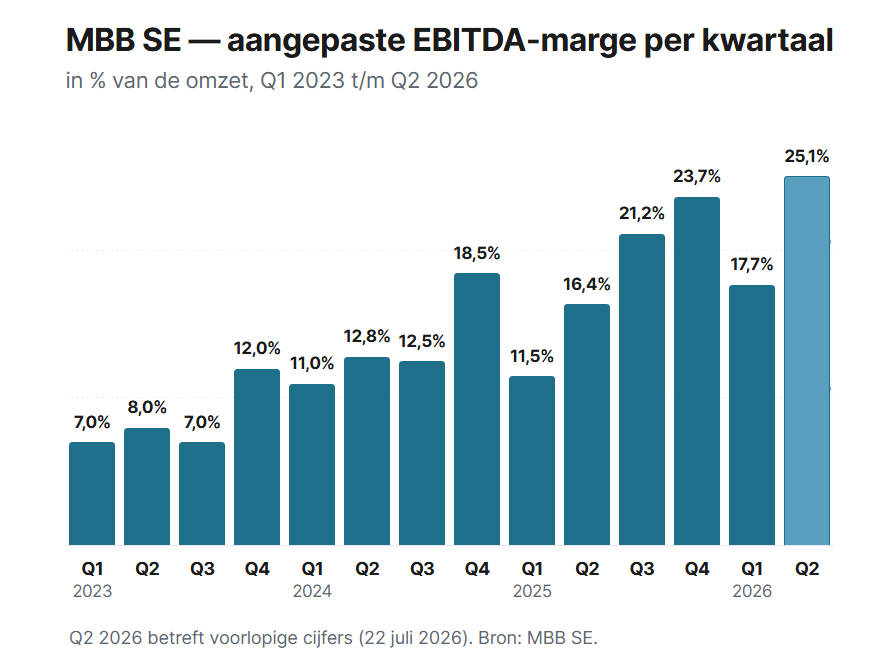
As a result, management has adjusted its margin outlook to a range of 18% to 20%, up from the previous 15% to 18%. The revenue outlook remains conservative, between EUR 1.1 billion and EUR 1.2 billion, in keeping with MBB's cautious strategy.
An important driver behind this success is subsidiary Friedrich Vorwerk, which accounts for around 63% of group revenue and roughly 80% of operating profit. This specialist in energy infrastructure for gas, electricity and hydrogen saw its half-year EBITDA rise by 70% to EUR 92.6 million on revenue growth of 11% to EUR 337.3 million. This results in a strong EBITDA margin of around 27.5%. Management attributes this jump to sustained successful staff recruitment, strong project execution and a solid order book, prompting Vorwerk too to raise its EBITDA guidance for 2026 from EUR 160 to 180 million to EUR 180 to 200 million.
The slight decline in total group revenue is attributable to the other portfolio components. In particular at Aumann, which is closely tied to the automotive industry, caution among carmakers is putting pressure on revenue, although management is keeping the margin on track through strict cost control. The fact that Aumann is absent from the overview of profit drivers for the second quarter underlines that this division remains the weak link for now.
This is offset by rock-solid financial firepower. The group's net liquidity stood at EUR 769 million at the end of June, of which EUR 431.9 million is directly available at the holding company level. With around 5.3 million shares outstanding, this puts roughly EUR 81 in cash per share on the balance sheet. At a share price of EUR 182.20, this means that almost 40% of the total market capitalisation consists of cash. MBB has held a large and growing cash position for some time now, which raises the question of when this capital will be put to work somewhat more aggressively.
Receive weekly insights in your inbox
Exclusive analyses and updates on family holding companies and global market developments.
Would you like more information about our services?
Get in touch
Disclaimer:
No rights can be derived from this publication. This is a publication of Tresor Capital. Reproduction of this document, or parts thereof, by third parties is only permitted after written consent and with reference to the source, Tresor Capital.
This publication has been compiled by Tresor Capital with the greatest possible care. The information is intended in a general sense and is not tailored to your individual situation. The information should therefore explicitly not be regarded as advice, an offer or a proposal to purchase or trade investment products and/or to take up investment services, nor as investment advice. The authors, Tresor Capital and/or its employees may hold positions in the securities discussed, for their own account or for their clients.
You should carefully consider the risks before you start investing. The value of your investments may fluctuate. Past performance is no guarantee of future results. You may lose (part of) your investment. Tresor Capital disclaims any liability for any inaccuracies or errors. This information is purely indicative and subject to change.
Read the full disclaimer at tresorcapitalnieuws.nl/disclaimer .
This article was translated automatically from Dutch using AI. In case of any difference, the Dutch original prevails. Read the original in Dutch.