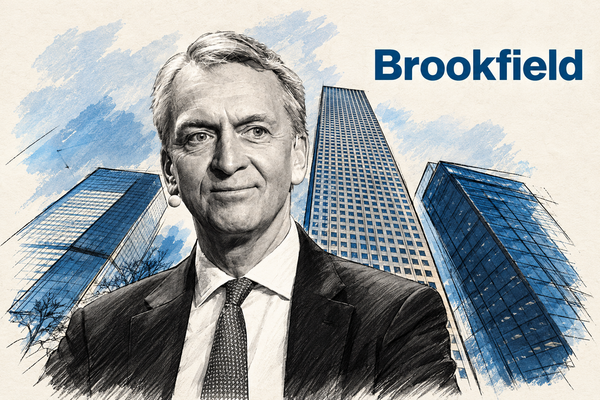
Family Holdings #33 - What to do with cash?
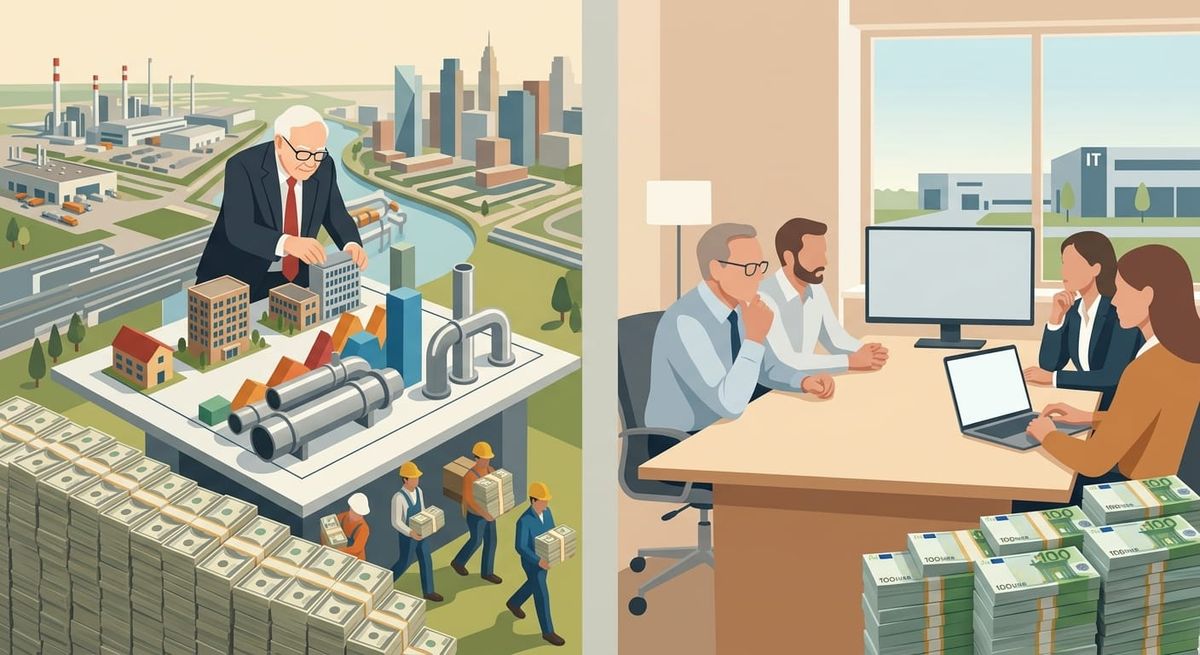
This week's topics:
MBB SE confirms, with the final half-year figures, its previously raised margin guidance of 18 to 20 percent, driven mainly by the excellent performance of anchor holding Friedrich Vorwerk. While subsidiaries such as Aumann and Delignit are cautiously diversifying beyond the weak automotive sector, and the smallest stake, in CT Formpolster, was divested to improve portfolio fit, the holding company remains cautious in the acquisition market.
TerraVest remains completely silent in its quarterly figures about the allegations surrounding chairman Pellerin, while the company itself is convincing operationally. Revenue rose by 14 percent and adjusted EBITDA by 28 percent, with data centre construction HVAC and Containment driving revenue growth of 83 percent. At the same time, the US market for tank trailers remains weak, meaning Entrans still is not delivering what was expected of it. Furthermore, management sold equity investments to put roughly the same amount into its own shares, a clear sign of where it sees the most value.
In Brief:
Chapters Group (Frankfurt: CHG) is expanding, through its platform Waterkant Software, into the market for software solutions for public health services. Portfolio company UniSoft, which has been supplying software solutions to German health services for more than thirty years with its core product Äskulab, acquired Krauth Digital Solutions. With this acquisition, UniSoft adds two specialised software solutions to its portfolio, namely SEU for the digital processing of school entry examinations and CISS for digital communication and data collection in infection control.
Greg Abel steps up investment pace at Berkshire Hathaway
The American investment holding company Berkshire Hathaway (New York: BRK.B) showed a clear acceleration in investment activity in the first half of the year under CEO Greg Abel. With the backing of chairman Warren Buffett, he is deploying capital on multiple fronts, through share buybacks, investments in listed companies and full company acquisitions. In early June, we already wrote that we were pleasantly surprised by the decisiveness with which the new CEO is operating. The past few months confirm that picture and suggest that, under Greg Abel, the holding company has a substantially better chance of putting its enormous cash position to productive use.
The second-quarter figures could be described as solid. The holding company's operating profit rose 16.3% in the second quarter to USD 12.98 billion. Net profit even doubled, to USD 25.7 billion, but that figure is distorted by unrealised gains on the equity portfolio and therefore says little about underlying performance. A caveat applies to operating profit as well. The exchange-rate effect on foreign-currency debt swung from a loss of USD 877 million last year to a gain of USD 326 million. Excluding that effect, profit growth was a still-solid 5.2%.
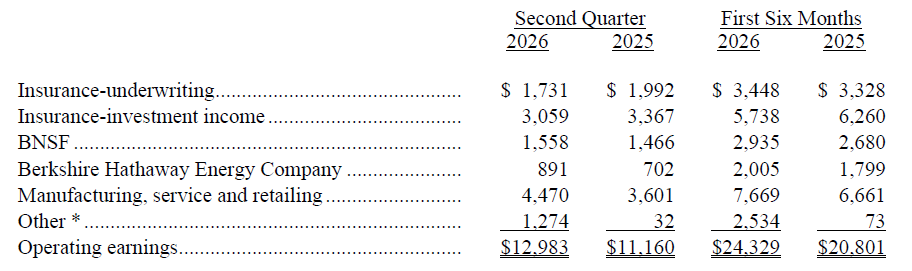
Railway subsidiary BNSF benefited from higher transport volumes and raised operating profit by 6.3% to USD 1.56 billion, although operating costs as a percentage of revenue remain clearly higher than at competitor Union Pacific, leaving the new CEO with some efficiency gains still to capture. Berkshire Hathaway Energy achieved operating profit of USD 891 million, up 26.9%, driven mainly by the American utilities and the natural gas pipelines. The industrial, service and retail businesses increased profit by 24.1% to USD 4.47 billion. Tellingly, OxyChem, acquired in January, already contributed USD 149 million to this segment's profit in the second quarter.
At the insurance operations, profit actually declined, falling 13.1% to USD 1.73 billion. Investment income from the insurers' portfolios fell 9.1% to USD 3.06 billion due to lower short-term interest rates. The decline was mainly attributable to car insurer GEICO, which grappled with a higher claims frequency and a higher average claims cost, while advertising and commission expenses also rose to reignite policy growth. With a combined ratio of 91.2%, comfortably below the 100 threshold at which insurance is profitable, the company still earns a healthy profit margin, although here too competitors such as Progressive are performing better. The float, the premium money Berkshire is allowed to invest before claims are paid out, also grew to around USD 177.5 billion. At the annual meeting, Greg Abel already warned that the insurance market is becoming more challenging and expects further cooling for the rest of the year.
$BRK.B The real reason Berkshire Hathaway started buying again 😂👇 pic.twitter.com/DMUPhOjEfH
— The Future Investors (@ftr_investors) August 11, 2026
The renewed share buyback programme is the most visible evidence of the more aggressive way in which the new chief executive wants to put the immense cash pile to work. After a pause of almost two years, share buybacks were resumed in March. In the first quarter, the amount remained modest at USD 235 million. In the second quarter, the holding company bought back USD 4.53 billion of its own shares, equal to 0.43% of the total number of shares outstanding. According to CNBC, that amount was actually somewhat below what some investors had expected beforehand.
Moreover, the pace of buybacks picked up during the quarter, even as the holding company's share price rose. The buybacks also continued at a rapid pace after the quarter closed. Between 30 June and 29 July, Berkshire bought back another 0.32% of its outstanding shares, for an amount that news agency Reuters puts at just over USD 3.3 billion. The changed division of roles within the buyback programme is also telling. From now on, the CEO, after consulting with the chairman, determines whether the share price is below the conservatively established intrinsic value. Greg Abel indicated earlier this year that buybacks were resumed because, in management's judgement, the intrinsic value of the shares was above the share price.
Berkshire also became more aggressive in its listed portfolio. In the second quarter, the holding company bought a net USD 19.78 billion worth of shares, made up of gross purchases of USD 23.47 billion and gross sales of USD 3.69 billion. This brought an end to a run of fourteen consecutive quarters in which Berkshire was a net seller of shares. The largest transaction was an increase in the stake in technology holding company Alphabet (Nasdaq: GOOGL) of around USD 10 billion, which means the parent company of Google now ranks among Berkshire's five largest listed holdings. Even excluding that Alphabet investment, there is still a substantial net purchase of shares. In an interview with CNBC in July, Warren Buffett revealed that the stake in Alphabet came about on his own initiative, admitting that he should have bought the stock earlier. The five largest holdings, Apple, American Express, Alphabet, Coca-Cola and Bank of America, now account for two-thirds of the listed portfolio.
Besides the listed portfolio, Berkshire was also active in acquiring entire companies. Two transactions were completed in quick succession. On 2 January 2026, the acquisition of chemicals company OxyChem was completed for USD 9.4 billion in cash. In late May, an agreement followed to acquire homebuilder Taylor Morrison, a transaction worth USD 8.5 billion (including debt), which was completed on 24 July. These are fine businesses that fit well with Berkshire's existing organisation and expertise, the chemicals arm building on the long-standing relationship with Occidental, and the homebuilder on Clayton Homes.
Berkshire is buying the homebuilder precisely at a time when margins in the sector are under pressure, as the slightly lower profit at Clayton Homes also shows. A classic Berkshire acquisition, going against the cycle. The two acquisitions also show that Berkshire does not necessarily need one exceptionally large acquisition to shrink its cash pile. A few acquisitions in the order of USD 10 billion, combined with equity investments and share buybacks, are already enough to stall the growth of the cash position. That is also evident from the figures, as the cash position fell from USD 380.2 billion at the end of March to USD 365.5 billion at the end of June. This brought an end to four years of uninterrupted growth in the cash position. The payment of around USD 6.8 billion for Taylor Morrison is not yet included in that figure, as the acquisition was only completed at the end of July, so the dent in the cash pile will grow somewhat larger still in the third quarter.

Greg Abel as a proven capital allocator
The decisiveness of the new CEO did not come out of nowhere. For decades, Greg Abel proved at Berkshire Hathaway Energy that he could allocate capital excellently, and was co-responsible there for average profit growth of 19% per year since 2000, partly through a series of acquisitions and strategic investments. He therefore has the investment expertise and, moreover, the temperament to make decisive calls, an area where Warren Buffett had become more cautious in recent years, perhaps partly due to his age.
His motto of operational excellence also appears to be paying off, as evidenced by the broadly shared profit growth at the subsidiaries. The fact that grandmaster Buffett recognised this himself and appointed his successor during his own lifetime (by announcing his own retirement) can be called a masterstroke. Greg Abel is now gaining experience as CEO under the watchful eye of one of the best capital allocators in the world. Regarding the acquisition of Taylor Morrison, Warren Buffett previously told CNBC that Greg Abel had arranged it faster and more smoothly than he himself could have.
The key question is whether Berkshire will continue to find sufficiently attractive opportunities to maintain this pace. The ultimate verdict on this capital allocation will also depend on the future returns on the capital deployed. But the initial signals after six months under Greg Abel's leadership are extraordinarily positive, and suggest that Berkshire's capital is finally being put to more productive use again.
The combination of a decisive, relatively young Greg Abel who, under the watchful eye of master investor Buffett, can put a huge cash pile to work using the same decades-old Berkshire principles appears to offer an attractive prospect for the holding company.
Receive weekly insights in your inbox
Exclusive analyses and updates on family holding companies and global market developments.
MBB keeps its cards close to its chest
The German investment holding company MBB SE (Frankfurt: MBB) published its final half-year results this week. There was not much new in them, as the holding company had already released preliminary figures last month and at that time also raised its margin guidance to a range of 18 to 20 percent. We discussed those figures extensively at the time; see the article below. In this piece, we take a closer look at what has emerged since then, from the results by holding to a number of notable moves in capital allocation.
 Joep Dikken
The results of the holdings
Friedrich Vorwerk remains the group's centre of gravity, accounting for approximately 63 percent of revenue and roughly 80 percent of operating profit. Revenue rose 17 percent in the second quarter to nearly €200 million, with an EBITDA margin of 30.7 percent, more than nine percentage points higher than a year earlier, driven by a higher share of in-house work within the ongoing major projects, continued staff recruitment and a larger contribution from joint ventures. The project pipeline underscores the scale at which the company operates, with large gas and electricity pipelines spanning several hundred kilometres that run through to 2028, complemented by hydrogen projects connecting electrolysers to the growing industrial infrastructure and the first European CO₂ transport projects run by major grid operators.
At IT service provider DTS the quarterly results were strikingly contradictory. Revenue at the specialist in data centres and cloud infrastructure fell by 21.5 percent. According to CEO Teichler, the cause lies in the global shortage of memory chips. This is leading to high component prices, projects that cannot be delivered, and Mittelstand customers postponing investments. Nevertheless, the group managed to improve its EBITDA margin by almost four percentage points to 17.3 percent, and it landed a new contract worth €30 million. Asked whether we can expect an IPO of DTS in the near future, Teichler hinted that this is indeed the plan, but that it is certainly not a priority for the coming years.
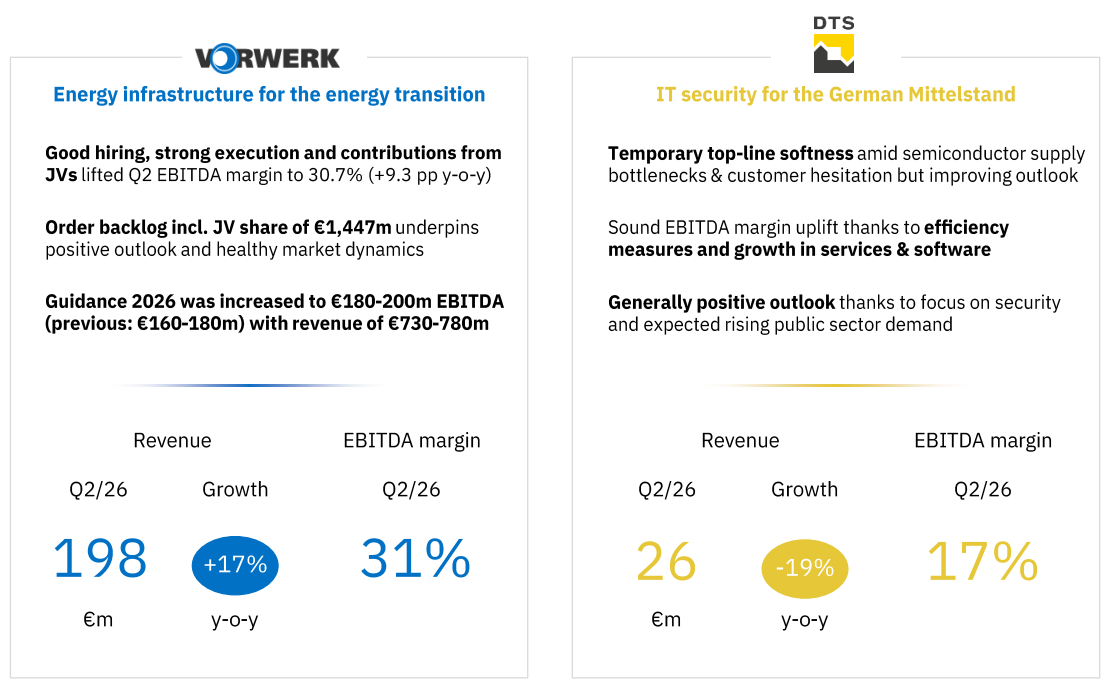
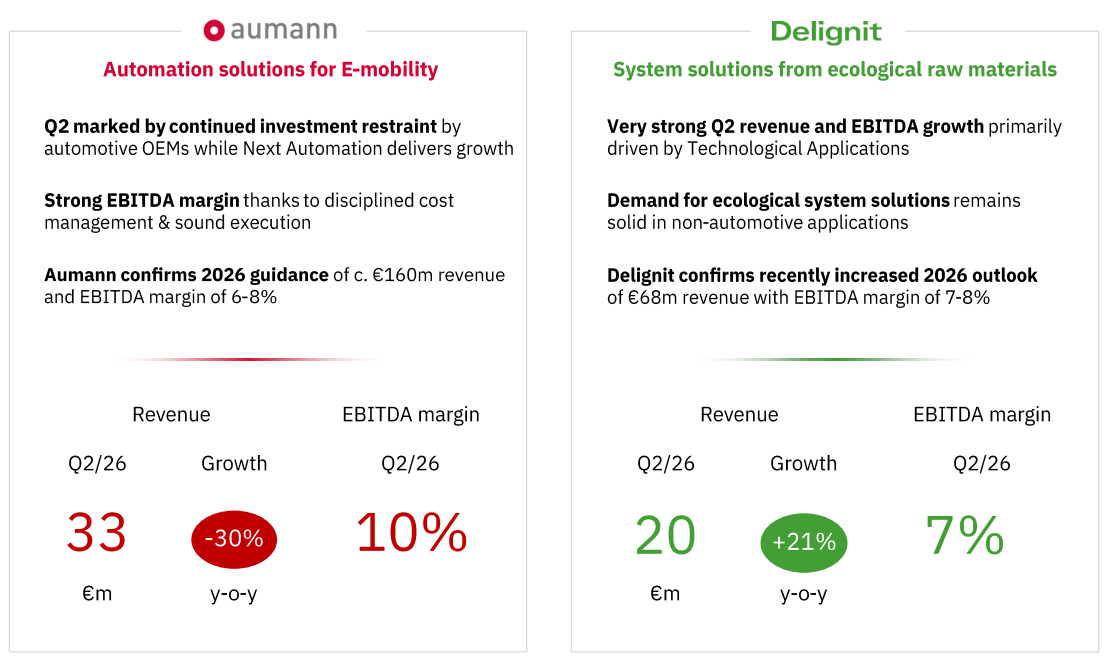
Aumann remained the ugly duckling, as expected. Revenue fell by 34.8 percent over the half-year and by 30 percent in the second quarter, while the margin remained virtually intact at 10.5 percent. That alone is a considerable achievement in a European automotive industry that is barely investing. Management has for some time been steering Aumann towards Next Automation, the division through which the company is moving beyond its classic automotive customer base into clean tech, aerospace and life sciences. That shift is now also becoming visible in the figures: order intake at Next Automation grew by 72 percent to €38 million and now accounts for 57.7 percent of total order intake, compared with 24.3 percent a year earlier.
At Delignit too, management is now looking more explicitly beyond the automotive industry, specifically via the Rail and Marine division. Revenue rose by 21 percent in the second quarter. Within this division, Delignit rents a production site from the Italian company Bellotti S.p.A., a party active in interior fittings for rail and shipping applications. That lease has now been extended until the end of January 2027, buying Delignit time to assess a definitive acquisition of the Bellotti activities while a restructuring procedure is under way there, which is expected to last into the autumn. A decision has not yet been made, but, according to Teichler, the train flooring activity could, like Next Automation at Aumann, become an attractive platform for further growth outside the automotive industry.
Capital allocation
At holding level too, there was again plenty of activity this quarter despite the absence of a major acquisition. MBB sold more than 1.3 million Aumann shares in the second quarter, bringing its stake down to 37.5 percent; at the end of 2025 this still stood at 47.8 percent. At Friedrich Vorwerk there is a subtler move hidden away that is not explicitly mentioned anywhere in the half-year report itself. After the first quarter, MBB announced that it had sold 897,190 shares, resulting in a stake of 39.78 percent. However, the half-year report states that the holding company sold a net 756,190 shares over the first six months and ended up at 40.48 percent. This means MBB must have bought back around 141,000 shares in the second quarter. The stake in Delignit was also slightly increased again this quarter.
A more interesting move followed after the quarter, with the sale of the entire stake in CT Formpolster. With €12.4 million in revenue and €0.4 million in EBITDA over the half-year, CT Formpolster was by far the smallest holding within the group. The motive is therefore not financial: according to Teichler, it is purely about focusing the team's attention on the existing portfolio. The buyer is no random party, namely Nexeras GmbH, founded by Christian Theurer and Constantin Mang. Mang was CEO of MBB from 2021 to 2025 and was thus no stranger to CT Formpolster either. With his new company, Mang may now be taking the first steps towards building a 'new MBB'; who knows, perhaps we will one day be able to buy shares in this again. We have always maintained good contacts with Mang, who gave a presentation on two occasions at a Tresor Capital client event.
During the conference call, we asked Teichler about the acquisition pipeline, and he was disarmingly honest about it. He stated that the market for attractive investments in Germany has clearly shrunk. MBB does not yet rule out the automotive industry, but the price would need to be exceptionally attractive for that. In popular sectors such as infrastructure, defence and IT, plenty of institutional capital is ready and waiting. That applies above all to the segment in which MBB operates, since a company worth €20 million is too small for the holding company to really make a difference. Teichler emphasised, however, that MBB is not an investment fund that constantly needs to produce new transactions. The holding company's success lies precisely in a small number of deals that in hindsight turned out to be right on target.
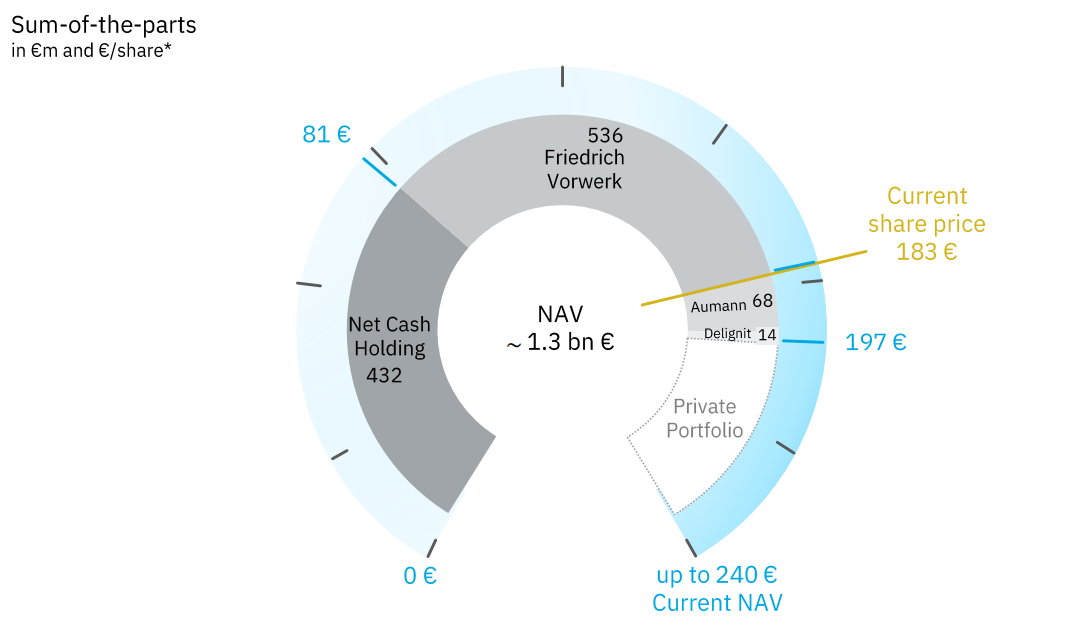
That patience also fits with the picture painted by the sum-of-the-parts valuation in the presentation. Net liquidity at holding level of €432 million equates to €81 per share, and together with the stakes in Friedrich Vorwerk, Aumann and Delignit, the liquid portfolio comes to €197 per share. At a share price of around €181, MBB is therefore trading below the value of its listed assets alone. The private portfolio, comprising DTS and Hanke, is not assigned any value at all in this, while management estimates the total intrinsic value at up to €240 per share. As long as that discrepancy persists, there is little pressure on MBB to rush into its next deal.
Strong third quarter for TerraVest
TerraVest Industries (Toronto: TVK) published its third-quarter results for fiscal year 2026 without devoting a single word to the allegations surrounding chairman Charles Pellerin, who is suspected of passing on inside information through family members. From a company that does not hold earnings calls, we expected little else, and to date no formal charges have been filed. Even so, a brief passage in the press release would have been very welcome. With a single explanatory paragraph, TerraVest could have largely removed the persistent doubt surrounding its top executive. As it stands, a cloud of uncertainty continues to hang over the stock.
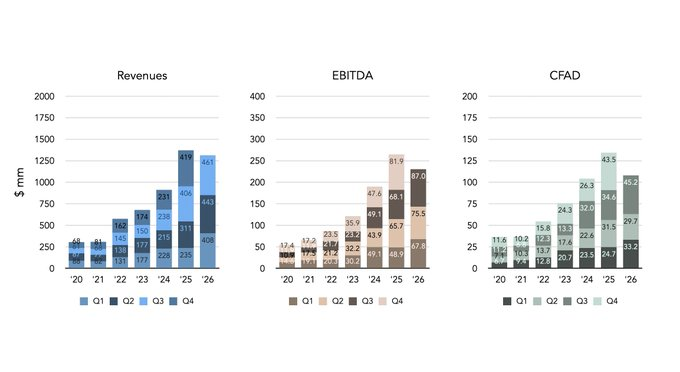
The figures themselves look particularly solid. Revenue came in at C$460.9 million versus C$405.7 million a year earlier, an increase of 14 percent. More important is the underlying trend, as the existing portfolio grew organically by 5 percent, marking a recovery from the 7 percent decline in the second quarter. Adjusted EBITDA rose by 28 percent, and net profit nearly tripled, a direct result of tight operational discipline. While the organisation grew considerably larger through recent acquisitions, administrative and selling expenses actually declined. In addition, the group effortlessly absorbed the usual pressure on working capital. Normally, this period represents a significant drain on the cash position, as TerraVest needs to build up substantial inventory ahead of winter. Thanks to longer payment terms with suppliers and a strong inflow of customer advances, cash flow over the first nine months remained extremely strong and well above last year's level.
Under the bonnet, performance varies sharply between divisions. The main driver was HVAC and Containment Equipment, where external revenue rose by as much as 83 percent. This performance is likely attributable to the rollout of large data centre projects and continued strong demand for industrial storage tanks. Segment profit increased more than ninefold, and the margin climbed from 16.1 percent a year earlier to an impressive 20.5 percent. By contrast, Compressed Gas Equipment, which houses Entrans, is where the pain is being felt. Revenue in this division shrank by 15 percent. Management states that US demand for tank trailers is weak and will likely remain weak in the near term. As a result, the expected return from the Entrans acquisition still has not materialised at the pace that was hoped for. The Service division held up well amid this turmoil, delivering a stable contribution to the total with a solid operating margin of 15 percent.
Big boy! 170,000 pound free water knock out fresh off the line from Argo $TVK.TO
— C.J. (@CJ0pp3l) August 6, 2026
-> integrating heating, separation, and solids-management systems into one process vessel pic.twitter.com/FgwUDXAkGB
An illustration of the work carried out by TerraVest's companies. This pressure vessel of more than 77 tonnes, built by subsidiary Argo, separates water from the oil and gas stream right at the wellhead, combining heating, separation and solids removal into a single installation.
Finally, capital allocation deserves attention. TerraVest's balance sheet has long included equity investments for which it has never really been made clear what the portfolio actually consists of. It is therefore interesting that the group sold C$29.2 million of these investments this quarter, in order to put almost exactly the same amount into buying back 259,915 of its own shares, at an average price of around C$115 each. Where management saw the most value at that moment is not hard to guess. Incidentally, that buyback programme was already in place before the allegations surrounding Pellerin came to light. In April, TerraVest set up an Automatic Share Purchase Plan, allowing shares to be repurchased automatically on any trading day, including during so-called black-out periods in which the board itself may not trade. Filings show that purchases continued through 30 June, meaning the allegations surrounding the chairman did not halt the programme. As at the end of June, a sizeable pool of 1.3 million shares still remained under the authorisation, capacity that, in our view, TerraVest will likely continue to make use of at these valuations.
Operationally, then, TerraVest continues unabated, with a strong engine in HVAC and Containment more than offsetting the weakness in tank trailers. What would truly free up the stock is clarity regarding Pellerin. So far it remains nothing more than an allegation, without formal charges, but it is precisely this unanswered question that keeps the market in an information vacuum that the company itself could largely resolve. We therefore hope that the internal investigation by the remaining supervisory board members will soon provide clarity.
Receive weekly insights in your inbox
Exclusive analyses and updates on family holding companies and global market developments.
Would you like more information about our services?
Get in touch
Disclaimer:
No rights can be derived from this publication. This is a publication of Tresor Capital. Reproduction of this document, or parts of it, by third parties is only permitted after written consent and with reference to the source, Tresor Capital.
This publication has been compiled by Tresor Capital with the greatest possible care. The information is intended in a general sense and is not tailored to your individual situation. The information should therefore explicitly not be regarded as advice, an offer or a proposal to purchase or trade investment products and/or to make use of investment services, nor as investment advice. The authors, Tresor Capital and/or its employees may hold positions in the securities discussed, for their own account or on behalf of their clients.
You should carefully consider the risks before you start investing. The value of your investments can fluctuate. Past performance is no guarantee of future results. You may lose (part of) your invested capital. Tresor Capital disclaims any form of liability for any inaccuracies or errors. This information is purely indicative and subject to change.
Read the full disclaimer at tresorcapitalnieuws.nl/disclaimer .
This article was translated automatically from Dutch using AI. In case of any difference, the Dutch original prevails. Read the original in Dutch.